The Curb Before the Sweeper Arrives
A street cleaning sign asks one row of parking spaces to become a work area for a short interval. What it says determines whether the sweeper can reach the edge of the road at all.
In this story 5 sections
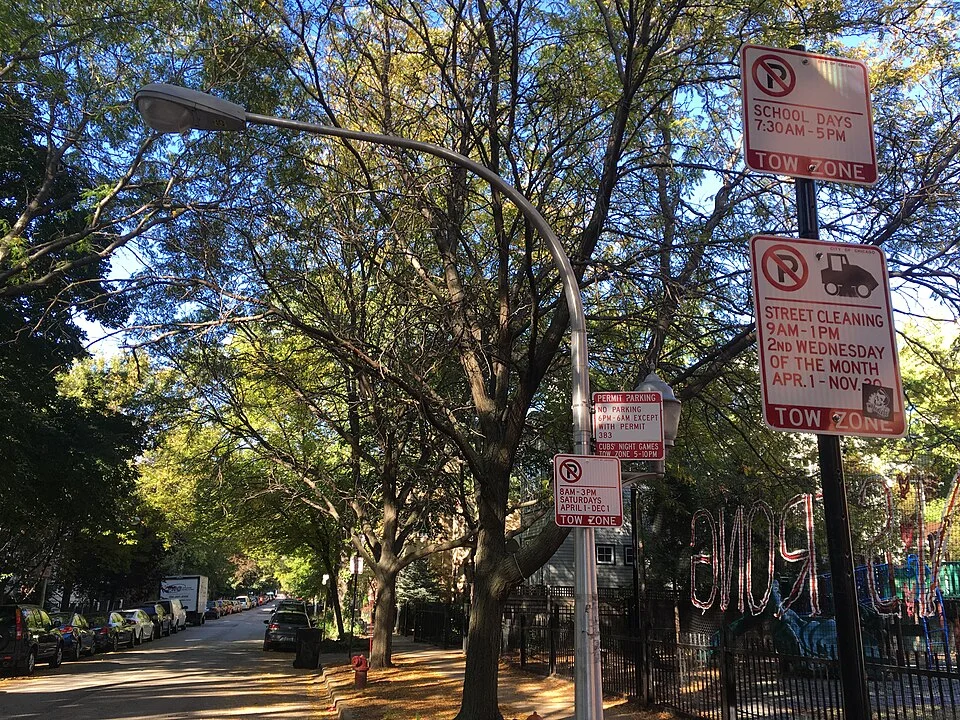
The street shown in Eric Fischer’s Chicago photograph has trees, vehicles and a collection of signs at the edge of the pavement. One sign includes a small silhouette of a street sweeping machine. It makes a narrow request on behalf of a large piece of equipment. Most of the time the curb serves other people. At a stated interval there has to be enough space beside it for someone to work along it in a continuous line. Parked vehicles in that line affect the work even when traffic in the middle of the road has plenty of room to move.
Fischer took the photograph in 2017. The signs are useful as a record of how an instruction can be delivered from a pole in a busy street, not as current instructions for where to park. Chicago's Department of Streets and Sanitation describes using temporary restrictions for scheduled sweeping and permanent signs for some recurring restrictions. The details belong to particular streets and schedules. Across those arrangements there is a common problem: the person who looks for a space in the evening and the person who drives down to clean the next day have to share the same piece of road without meeting each other.
Give the machine a clear edge
Debris collects in places a passing sweep down the middle of the road cannot reach. The gutter is a lower line next to the curb. Material washed or pushed along the pavement can settle there; leaves and other ordinary litter can stay when traffic goes by. To reach that edge a sweeper has to be able to approach it along the segment being cleaned. A road may look nearly empty and still have a long space of gutter out of reach where two vehicles remain. A brush with a path through the lane has a different reach from one kept to the centre of the lane by parked cars.
That is why the restriction can be limited to one part of the road instead of looking like a closure of the whole street. People may still need to travel past while a piece of the edge is being made clear. Think of two blocks with nearly the same length but different configurations. One block has a row of vehicles and one break at a crossing. The other has several driveways and a piece of curb that is kept clear for another purpose. The cleaning route has the same nominal distance along both. The way the sweeper can approach and leave the edge is different in each.
A sign does not have to give the operator's instructions to people parking. It does need to make the useful section available. A person taking the first space after the corner should know whether the restriction reaches that far. Someone leaving a vehicle on the opposite side should not have to guess that the nearest sign applies equally to both. Information about a particular side, segment and window in time all matters because the brush is aiming for a physically specific space.
A printed time needs a place and a date
A temporary sign can put an unusual date where a resident already looks for instructions. A permanent sign can help when the time repeats often enough to be stated as a regular rule. Chicago describes both approaches in its sanitation information. Each has a weakness if it is read without context. Someone might pass a permanent plate without noticing a temporary notice below it. Someone who checks a city schedule without checking the side of the street can arrive at the correct hour for a different segment. A sign's job is to relate the schedule to the pavement a driver is considering.
Consider an invented block where the east side is cleared on the first morning and the west side is cleared on another. The two runs leave some parking options in the area while giving the sweeper a clear path in turn. An online calendar listing the neighbourhood and both dates is useful for planning. It cannot help at the last step unless the dates stay attached to the sides they describe. The notice on the street needs to carry that relation too. A bare arrow could point toward a restriction, a boundary or the direction of a different sign. Words and visible boundaries make it easier to check the intended movement.
A traveller arriving close to the end of a posting window may see no machine. A sweeper could arrive earlier or later in the interval depending on the route. Its absence from view does not determine what the sign says. Clear public information makes the period of the restriction readable rather than forcing each visitor to estimate a route from the work vehicle's position. It has a second role for people who normally park only on one side. The posted interval gives them a reason to plan where their car will be before the curb becomes needed for work.
Go through the notice in the order a visitor finds it
The photograph has more than one instruction close together. From a moving vehicle or a distance on foot, someone has only a limited amount of time to choose which notice to read first. A recognisable machine symbol can point them to the type of work. Nearer the support, the day, hour and applicable direction deserve prominent space. Smaller details can make precise where a run begins or point a person to current information. A pictogram alone may identify a sweeper and still leave every important decision about the parking restriction unanswered.
There is a design problem when notices are placed too far apart to see both ends of a segment. A person may have to walk back past two other vehicles or turn a bend to discover the applicable sign. Someone approaching from the opposite direction may come upon the same information in a reversed order. A notice intended to clarify which spaces are affected needs to be legible from the ways people actually arrive. As much as possible it should be easy to see which arrow belongs to which rule. Old or redundant notices left behind can make this test fail even when the newest one is clear on its own.
Digital information and a notice at the curb can meet different needs. A resident can look up a schedule before leaving a car overnight. A visitor can read a sign with no advance knowledge of the city's system. If a change moves the day of work, both forms of information can help; they can also contradict one another if each is updated in isolation. A shared reference to a block or an unambiguous pair of endpoints helps a person tell whether the two notices concern the same place.
The schedule is also a chain of jobs
Putting up a sign is one job. Moving a parked car is another. Carrying the equipment along the designated segment is a third. The sequence takes place across different people's working days. If the work gets delayed and a notice is not removed or updated, someone may continue avoiding the space even though the old request no longer helps the crew. If the sign goes up very late, a person who would willingly move the car may not see it while there is still time. The clarity of the street's arrangements depends on timing as well as on the typography.
A way of evaluating a run is to ask what area was actually reachable. A record that says the machine went down a block is useful, but it does not establish that every part of the gutter could be treated. Note where access was blocked or where another condition prevented work. The answer could affect a later schedule, a choice about where another notice should stand or an estimate of how long a following visit will take. The idea is to connect the travel of a piece of equipment with the part of the street it was there to clean.
Local conditions can affect the result even when the signs stand in suitable places. Material arriving soon after a sweep can make the same edge look unchanged to a person who missed the visit. A stretch under trees can collect debris differently from one in the open, and a location next to a busy shop can have its own rhythm. A report about one place should name which part of the curb it concerns and when it was observed. A photograph of another stretch at another hour will not settle whether the operation there went as planned.
Leave the street ready to change back
After the interval is over, the same edge can serve ordinary parking again where allowed. The pavement, gutter and neighbouring signs are still in the same places. The useful difference is that a short area for work was made available in time and then stopped asking passing people to reserve it. An expired temporary notice should not become a continuing puzzle for someone who comes along with no memory of the sweep.
Look back at the tiny machine in the photograph. It is a compact clue about a vehicle whose working area is several times the size of the sign. To understand the information, follow it outward to the nearest corner, the row of parking spaces and the line the brush has to reach. A clear notice makes it possible for people to prepare that line of curb before the equipment arrives. Once it has done its job, the street can go back to asking the next visitor an ordinary question about where to park.