When the Fremont Bridge Lifts
A drawbridge alternates between a street crossing and room for vessels. Seattle’s Fremont Bridge shows why people need clear cues as the same location changes from one use to the other.
In this story 5 sections
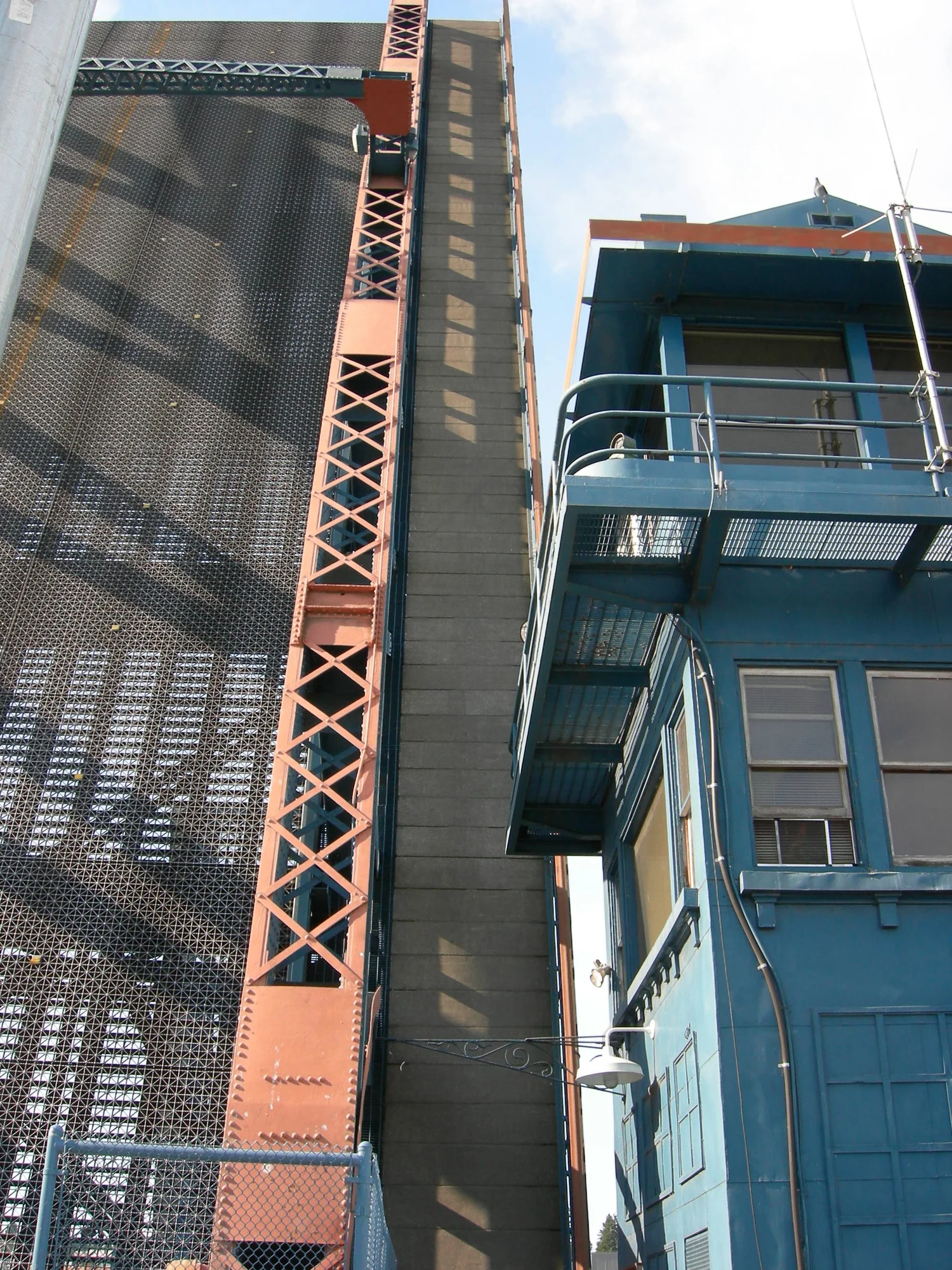
The orange edge of a bridge stands almost upright at the left of Joe Mabel’s photograph. A blue building rises beside it. Black metal on the bridge occupies a surface that looks more like a wall than a way to cross. The picture was taken at Seattle’s Fremont Bridge, from near one end of the movable span. At other moments much of that conspicuous piece is part of a horizontal connection. A person approaching it then might give little thought to what the surface would look like set at an angle beside the canal.
The Seattle Department of Transportation describes Fremont Bridge as a link across the Lake Washington Ship Canal between Fremont and Queen Anne. Along the canal itself is another route requiring a different set of clearances. The bridge has to serve both directions of travel: across the canal at street level and through it by water. There is a reason the same opening can be called a routine event and an inconvenience. Its effect depends on which journey a person came to make. The work of running such a crossing includes making that change of use understandable from several approaches.
A short wait is still something to plan for
A person cycling to another neighbourhood may find that the usual route is temporarily interrupted. A boat traveling along the canal may be waiting for space beneath the same part of the bridge. The portion of street that matters is short. But all the trips arriving during the interval still have to go somewhere. On land they collect toward the crossing; on water there has to be a way to wait for the passage to be ready. Farther away, someone choosing whether to leave later or take another route may want to know more than the people already waiting need to know.
It helps to separate a bridge opening from a closure lasting hours or days. The day's travel can normally resume across the same structure after an ordinary lift. A driver need not imagine the street connection has disappeared for the afternoon merely because traffic is stopped. A planned maintenance closure makes a different demand. The user may need diversion advice well before reaching the canal. A status message can describe which kind of interruption is in progress so people can place it in their journey rather than reading the same word closed as an all-purpose condition.
The closest useful alternative also depends on how the trip is being made. A good road detour need not be convenient for someone walking. A bicycle route through an adjoining network may arrive on the wrong side of the canal for a direct continuation. Someone transferring to transit could care more about time lost at the next connection than about the number of metres traveled. For some people standing at the crossing a wait will be easier than reaching another bridge. The useful public message permits that choice without guessing which journey is most important.
What the bridge looks like from each side
During an opening, several things change in a sequence. People traveling on the road and the walking or cycling approaches have to be stopped before the span moves. The movable portions leave the position that makes a continuous street. Vessels have room to pass after the bridge is ready for them. At the end, the street needs to be restored to a condition in which people can cross before ordinary movement starts again. The point from a passerby's perspective is that different uses are available at different times. An apparent gap narrowing is not the same as the crossing being declared available.
Mabel's photograph is especially useful for seeing the view of someone on land. The movable section looks taller than the building beside it would suggest in most bridge photographs. It makes the interruption very clear. Someone approaching at street level is likely to learn about it earlier from signals or barriers. The people in a boat see the relationship between the channel and what is still overhead. They do not necessarily have a view of the decisions on the roadway. Descriptions for the public can be precise without requiring either group to reconstruct what the other can see.
It is tempting to explain the operation from only one point and call the result complete. Imagine describing an opening to someone on a footway beside the canal. They may see a boat approach but not see a car queue beginning on the other side. Describing the same event to a driver waiting beyond a bend in the street can require exactly the opposite emphasis. The bridge's own location is common to both descriptions. The details that help a person decide what to do change with their direction and distance from it.
An arrangement for recurring conflicts
Seattle publishes information for people using its movable bridges, including the arrangements for requesting openings and when different conditions apply. Those are operating details for a current trip, best checked with the official information rather than read from a photo of an ordinary lift. The broader point is that the bridge operates where two different networks need the same clear space. A request or a schedule makes it possible to establish when one use can temporarily take priority. Without an agreed system, both journeys could arrive expecting the last available piece of the route at the same moment.
The scale of a recurring delay matters. A single interruption may seem too short to mention in a discussion of transport. The regular opportunity for waiting can matter to a route used every day. What should a planner record? The duration of one lift describes how long the street connection was unavailable in one event. It need not describe the time before the last delayed traveller clears the next intersection. Enough traffic arriving in the interval can leave a queue that takes time to disperse. On other occasions the wait can end for almost everyone as soon as the crossing reopens.
For boats, the perspective is reversed. The raised span lets a particular route continue. A schedule or set of expectations helps people consider the rest of the trip before they arrive there. At the level of a city service, an opening is both an interruption to one flow and a way of keeping another flow possible. Both facts matter when someone is trying to understand why the bridge does not spend every minute in the position they would personally find most convenient.
It can be useful to describe the two routes on separate diagrams before bringing them together. The street plan shows where people and vehicles can approach the bridge. A canal map shows how the passage fits among other stretches of water. Mark the same span on each and it becomes clear why a notice written for one traveller may leave out the next decision the other has to make.
Make the waiting space part of the design
Imagine walking toward the bridge behind a few people who stop in different positions as they see a restriction. A queue can leave room on the approach for others to turn, or it can accidentally occupy the space someone needs to reach a crossing or a different path. The surrounding pavement matters during the lift even though it does not move at all. If signs and barriers make the safe waiting areas readily recognizable, visitors do not have to invent a place to stand at the last moment. They can also understand when the active crossing resumes without relying solely on the movement of people ahead.
There is room here for both early information and later confirmation. An update available before departure helps someone with a tight connection. A visible cue at the bridge remains valuable to someone who never opened that update and to someone who arrives after conditions have changed. These notices have different ways of saying the same thing. One can identify a particular bridge in a network, while the other can address a place a person already sees in front of them. If the location or status is ambiguous in either context, recent information can still be difficult to use.
Waiting also makes approaches with different needs visible. A person walking slowly or using a mobility aid may take longer to reach a place out of the path of another queue. Someone arriving by bicycle may need a clear cue about where to wait in relation to the footway. The sequence can remain very familiar to people who use it every day and still create a problem for newcomers if there is no legible path to a suitable place. A clear approach is a kind of useful public information in its own right.
See the crossing and the passage together
The photo turns a roadway into an unmistakably vertical object. That view makes the bridge's two jobs easier to separate. A wide horizontal surface supplies the ordinary connection from one neighbourhood to another. Raising it makes a different journey possible along the canal. When the traverse is restored, the ordinary street becomes familiar enough to take for granted again.
A good bridge notice asks a person to interpret only the consequences that matter to the next few minutes or the next connection. It can tell someone when to wait, which movement is possible or where to check a change. The large orange edge supplies a memorable image. Making its movement an ordinary part of a city trip depends on smaller pieces of public information, usable from both land and water, while the bridge changes roles.