The Hours on a Street Party Closure
Tables appear on a street for a short time. A useful notice explains where vehicles must stop, what access is available and when the street will return to its ordinary use.
In this story 5 sections
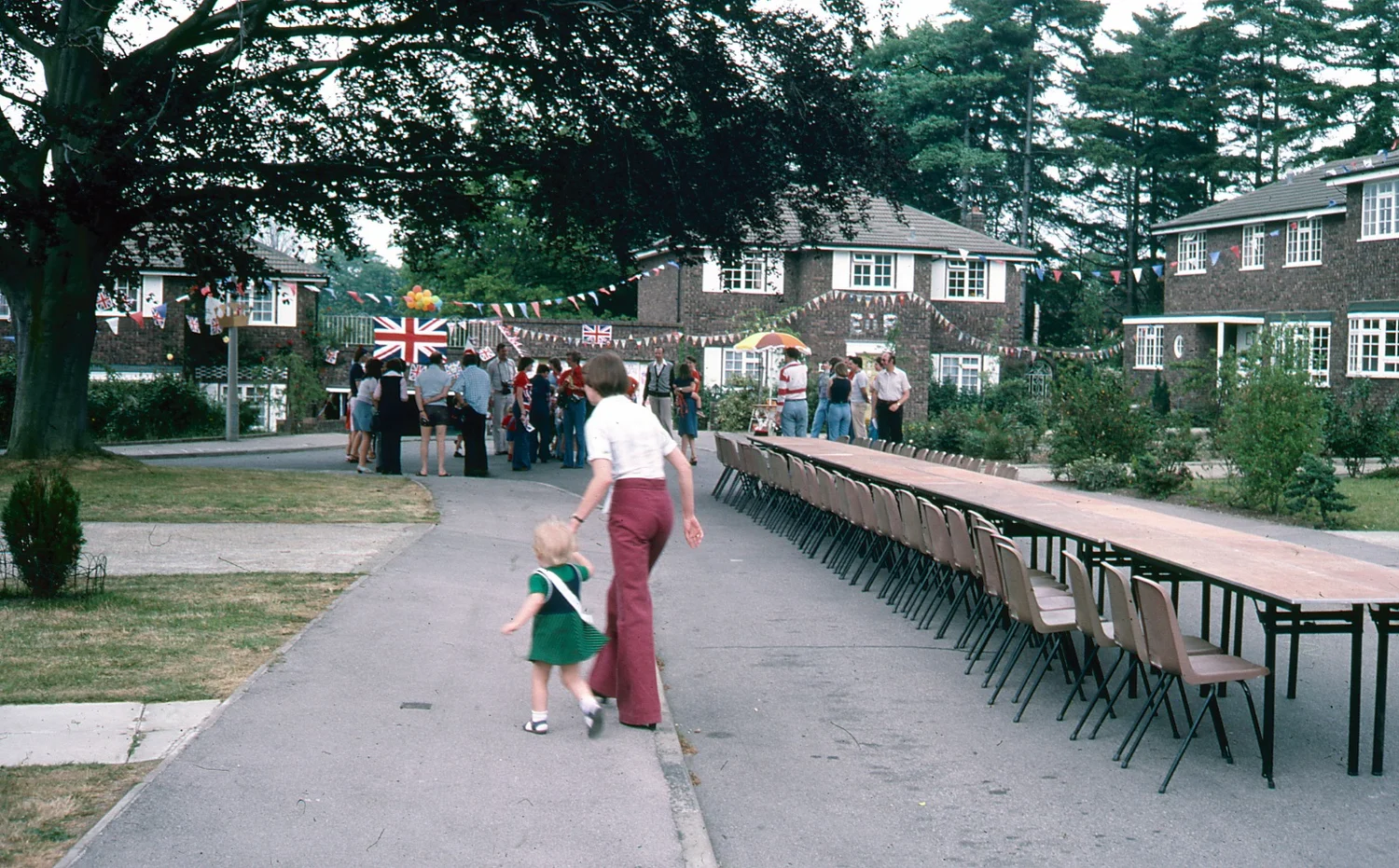
The tables in Chris Mitchell's photograph are long enough to make a new line down the street. Chairs sit where a vehicle might ordinarily pass. Farther along are people and bunting. The photograph shows a Silver Jubilee street party in Bracknell in 1977. Someone looking at it can see at once why a street is an attractive place to put several tables together. The photo is also one of the few kinds of record that does not need to say when the arrangement starts or what happens if a driver reaches its edge.
A notice announcing a temporary closure has the opposite job. Its first responsibility is to describe a future situation to somebody who may not attend. A resident may need to get back to a driveway. A delivery may already be expected. A person walking through might be very welcome while needing to know which parts of the street remain usable. The same tables that tell one audience a party is under way tell another audience that they need different information.
First establish what is being closed
The English government's guidance describes small neighbourhood street parties and directs organisers towards their local councils where a closure is needed. Bracknell Forest's guide also distinguishes gatherings on private land from events that seek a road closure. Procedures and conditions must be checked with the responsible authority for an actual proposal. The old photograph records a party, not how a present organiser would obtain permission for the same arrangement.
Suppose a short residential road has two junctions and a branch to a small parking area. Saying the street will be closed may give the name without identifying a segment. Is the whole road unavailable to through traffic, or only a section between two named points? Does the branch meet the closed part? A simple plan with the relevant edges marked can be far more useful than a copied map with an arrow at the middle of the party.
The names matter because roads have addresses as well as people who pass along them. A vehicle can arrive at a recognised street from the other direction. A neighbour may use a name for a small passage that does not appear on an official map. Giving a street name and clear boundaries identifies the area to both kinds of reader. The map can then show which entrances lie on each side. None of those details is apparent from the middle of a long line of tables.
Make two sets of times if there are two sets of times
The afternoon gathering and the closure do not have to last for exactly the same interval. Furniture needs to arrive and leave. The authority's approved arrangements, if applicable, may specify when closures begin and end. Announcing only when the food is served leaves too much to inference. A notice should let a person find the date and the period that affects a journey whether or not they care when the party starts.
For a fictitious example, suppose the planned gathering runs from two to four, with time on each side for setting up and clearing away. Someone collecting a neighbour at half past one should compare their trip with the authorised closure hours, not the time written on the invitation. Someone preparing a table knows why it cannot simply be put out as soon as the chairs are ready. Two schedules printed separately give both parties a usable answer.
Write the day and date together, especially on a notice that might be forwarded. A sheet that says this Sunday can still be read the following week. If the organisers change a proposed time, clearly distinguish the updated plan from a previous one and check whether the authority needs to approve the change. Printing a new invitation has no independent power to change a closure arrangement. The time that matters is the one people are actually entitled to rely on.
People use the edge in different ways
One part of an event plan can deal with how someone reaches a particular property. Another might address traffic that normally goes through without stopping. A person walking on the other side of the street needs different information from a driver intending to pass through. If the route includes public transport, it is especially important to consult the relevant authority or operator rather than assuming a quiet stretch is used only by the addresses on it. The national guidance asks organisers to consider whether the road carries a bus route or through traffic.
Emergency access is more than a sentence in an email. The relevant arrangements have to be agreed through the official process and followed on the day. A convenient place for a heavy table in a drawing may be the space that needs to stay clear under a particular plan. A person managing the event should not infer from a photograph or an example like this one that a particular route or barrier arrangement will meet local requirements. What matters to a neighbour reading the notice is that the approved arrangement is communicated where it affects their planned movement.
The same surface can thus have several practical boundaries. There is the point past which ordinary through driving is restricted. There is the edge of the area occupied by objects or crowds. There may be a route kept clear for other movement under the approved conditions. Drawing each with a separate description keeps a closure from being mistaken for permission to use every square metre behind a sign.
Consider the person who has no invitation
People who are invited can ask the host what to do. People who are not may learn about the change from a transit notice, a neighbour or a board at a junction. A readable notice anticipates the most ordinary questions: what is happening, at what named place, on what date and time, and which official or organiser channel can answer a question. It gives the part that affects travel before it gives the full programme.
A building can also have several households or several businesses using one address. Telling one person on each side of the street may not reach occupants who depend on the other entrance. A local authority may ask an applicant about the people and premises consulted. The practical exercise is to identify where the effects reach rather than assume that a list of invited participants doubles as a list of affected neighbours. English government guidance specifically asks about impacts on properties and businesses and about consultation with neighbours.
Not everybody can enlarge a map image or read a notice standing in the same place. Give the limits of the closure in words as well as on the plan. Make the date and hours easy to compare with a personal calendar. Print the contact in a form that can be used independently of a code on the sign. These are ordinary communication choices, but they let a person who does not know the local landmark still make a decent decision.
Keep an end to the event in the plan
The first person to receive a later version of a notice may not be the last person to rely on the old one. If a proposed location changes, someone who keeps the printed announcement should be able to tell which notice is current. Date the revision, remove or clearly supersede the earlier copies at the places where they were distributed, and route people to the authority's information if there is a doubt. This is especially useful when details are passed along in neighbourhood chats by people outside the organising group.
The same approach helps if the gathering is called off. A message should distinguish cancellation of the party from the status of the road restriction; they need to match the official arrangement before travellers can rely on a reopening. The public-facing change needs enough detail to identify the street and date. An unlabelled message saying cancelled cannot do that once it has left the conversation that gave it meaning.
The work after the last plate has been collected is part of using a public road for a short time. Tables and chairs go back into storage. Temporary equipment or signs need to be handled in accordance with the arrangements. A visitor leaving at the end may see nothing unusual about a street returning to its old use. In the plan it is a specific change, with a time and responsibilities attached.
A useful rehearsal is to read only the closure notice and ask what a person arriving after the event should expect. Then check it against the plan for clearing the area. A gap on paper may be easy to fix before the day. It is much harder to discover it when a driver already expects to use the road. Giving the street back is easier to plan when the time has been clear from the first announcement.
In the old Bracknell photograph the line of tables makes the middle of the street look pleasantly unlike a road. That is what the participants had the chance to enjoy. The useful modern notice does not have to reproduce the mood. It has to put a place and a duration around the change, so a neighbour can decide whether to come, go another way or be there when the chairs are taken away.