Watch the Last Metre of a Street Crossing
A marked crossing connects two routes only when people can comfortably make the transition at both ends. Start on the pavement and pay attention to where it leads.
In this story 6 sections
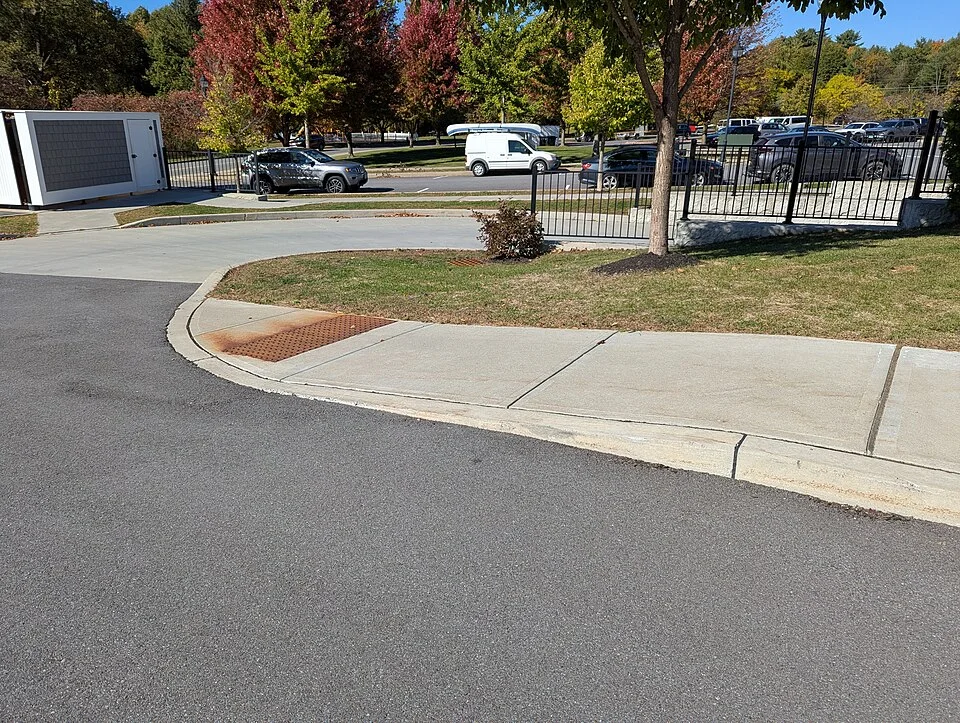
On a printed street plan, a crossing is a clean connection. Walk toward it and you encounter a bend, a change of slope, a line of raised marks, the gutter and the painted route across the road. The last metre asks you to interpret several signals at once. If the ramp points at the middle of the intersection while the route is offset to one side, the lines of movement do not agree. Someone unfamiliar with the corner has less room to work out the difference than someone with years of practice there.
Begin before the curb
Stand out of the way on the approach and note what you can tell without getting to the road. A lamp post or sign can occupy the space where someone needs to turn. A curb ramp can be suitably shaped by itself and awkward to reach from the rest of the pavement. Try sketching the pedestrian route as a strip of usable space rather than as one line. Imagine somebody coming from a different side of the corner. The sketch will often reveal two turns and a pause where you would have drawn a single movement.
The raised pattern seen at some crossings provides a detectable warning near certain transitions. Its purpose is different from the function of a painted stripe. People who use vision to find the route may benefit from contrast; those relying on touch need a legible surface underfoot or detectable with a cane. The U.S. Access Board’s guidance is one example of detailed requirements that refer to ramp type, placement and the pedestrian route. Design requirements vary by jurisdiction. An ordinary observer can identify a problem to report without making a claim about whether the corner meets a particular standard.
Read the gutter as part of the route
Drainage lines and walking lines share limited space. A shallow depression may be inconsequential on a dry day and collect water across the entire route after rain. A transition close to flush is useful when its meeting with the road stays clear and understandable. Snow, gravel, a temporary sign or work at the curb can change the available passage even if the permanent construction has not changed. Note the time and conditions as carefully as the obstruction.
Then check the other side from a legal, safe observation point. A crossing can be comfortable in one direction and demanding in the other. The near corner may have a straightforward approach and the far side may require a sharp turn into a narrow space. If a street serves a school or bus stop, movement in one direction may be much more concentrated at particular hours. Conditions under that load will tell you a different story from the same corner on an empty morning.
The time allowed is part of the design
A signal adds a sequence of events to the geometry. Pedestrians can arrive from several directions and wait in different places. Before crossing, they need to know which invitation to move applies to them. A route can appear direct on the ground but be hard to read if the visible indication is farther away than expected or if several traffic sounds are present at once. If the corner has a push button or an audible cue, notice where you would find it and whether you could get to it without leaving the area in which you would otherwise wait. Keep the user’s route to the device separate from the vehicle route through the intersection.
When observing from a safe position, distinguish waiting to start from the time available to get across. People may step off the curb at different parts of a signal cycle. Some will respond almost immediately; others will spend time getting oriented, attending to someone else or waiting for a turning vehicle to clear the way. A person’s crossing time also depends on the length and surface of the usable path, as distinct from the straight distance measured on a map. Local rules and design requirements define what the different indications mean. Counting seconds from one unexplained signal change can give a misleading verdict. If timing is part of a report, identify the display you could see and what you actually observed.
A quieter intersection without a signal can be more legible in one respect and less legible in another. A person may not have to hunt for a button, but may need to judge whether drivers have noticed them. Sight can be obstructed by parking or by a corner that sends people into the roadway before they can see enough of it. Note where a person could stand while still off the carriageway, and what direction they would need to see from there. This is a practical way to describe why a crossing that works when the curb is clear might be much harder to use during a delivery.
Draw the route for a person who needs a level pause
Sketch an approach, a waiting area and an exit. Imagine that a person wants to stop before entering the road. Where can they pause without having to turn on a slope? Would pausing there block someone trying to move past on the pavement? Does the route carry them naturally toward the marks for the crossing, or does it require a turn at the bottom surrounded by traffic? A diagram with a small square for the waiting position is often clearer than an arrow that carries movement straight through. It makes room for a stage of the journey that is easy for a fast walker to forget.
Different approaches may compete over the same space. People following the same pavement past the corner may have to pass between two groups who are waiting to cross at right angles. A corner with ramps oriented separately toward the two crossings can offer useful information about direction; having separate facilities does not by itself solve the overlap if the approach has become narrow. Conversely, a broad transition that works for several movements may need other strong cues about where each crossing begins. Notice the path as it would be used rather than trying to diagnose a whole layout from the name of its ramp type.
Be careful when interpreting the experience of someone you watch. A slow turn may reflect unfamiliar surroundings, an approaching car, a slippery patch, a difficult angle or something entirely unrelated to the street. An observer can record how often the same part of the path causes a clear interruption without claiming to know what any particular person understood. If you are part of a longer neighbourhood project, include people who actually rely on different routes and forms of access. A site visit and an honest conversation provide evidence that a photograph taken from eye level cannot.
Separate permanent choices from possible repairs
Suppose rain has covered detectable paving with a sheet of thin water. Begin with what happened and under what conditions. One cause might be a blocked drainage inlet, another might be the direction of the surface, and another might be water running from work farther up the street. The standing water is one observation. A lasting change to the corner, a request to clear the inlet and a maintenance check at the next rain are different responses. The distinction matters because the person who can make a small repair may not be the one authorised to approve a new design.
The same division applies to an object blocking the pavement. A temporary sign can be moved by the party responsible; a permanent post may need an approved alteration; a delivery pattern might involve where and when trucks have somewhere lawful to stop. A diagram that shows the full usable route can be useful in each case, but the evidence that prompts a response will vary. Put repeated observations with their dates instead of changing a report about an intermittent problem into a claim that a location is always obstructed.
Report the place someone needs to find
Good notes include the street names, which corner, the direction of travel, and what obstructs the usable route. If it is safe and appropriate to take a photograph, show both the approach and the transition without identifying bystanders. “Water across the full ramp after rain on the northeast corner” is easier to investigate than “the crossing is bad.” That precision does not settle the design. It lets the person responsible locate what a pedestrian experienced and see which part of the crossing caused it.
If you receive a response, keep it next to the initial note. A reply that a request has been received is different from an inspection result or a description of work scheduled. A thread with both an original observation and a dated response makes it easier to check later if anything has changed. In the meantime, treat the crossing as part of a larger trip. Its real performance is the ease with which somebody can move from a place they are allowed to be to another place they need to reach, in both directions and under conditions that are ordinary for that street.
A temporary detour deserves the same check. A sign can announce a closed pavement well before it offers a usable alternative. Record the place where the alternative first becomes clear and whether it is reached before the original route ends. That information can help distinguish a missing connection from an adequate detour that people cannot find.