The Space Around a Bike Rack
A rack occupies a slim patch of sidewalk until people use it. A better drawing starts with the bikes, the door and the people trying to pass.
In this story 5 sections
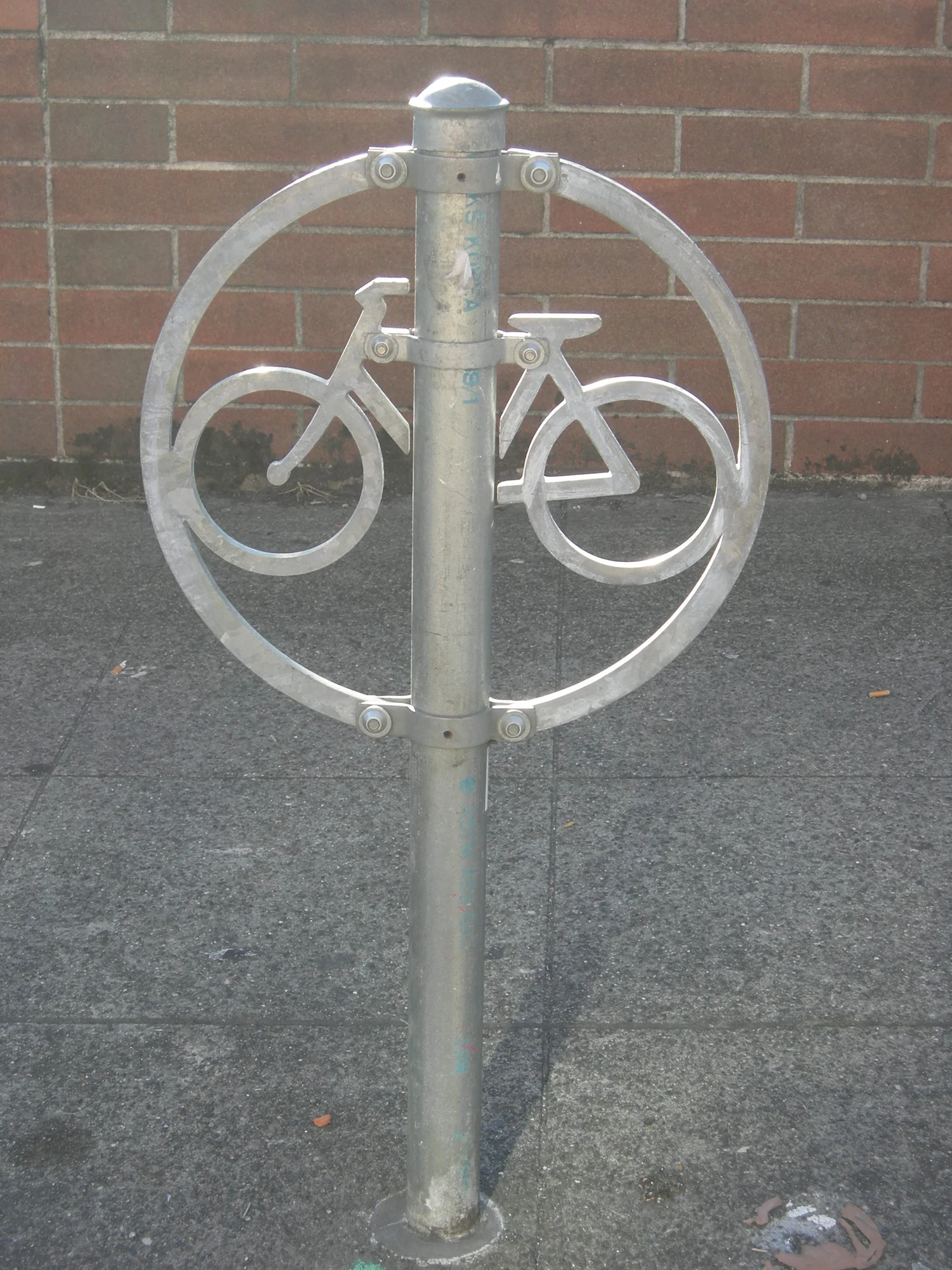
An empty bicycle rack can look wonderfully unobtrusive. A loop of metal rises out of the pavement, sometimes no wider at the base than a person’s shoulders. A photograph taken the morning it is installed will show how much pavement was disturbed, whether the fastening looks neat and how the metal fits among other fixtures. It is a poor picture of what a person walking down that street will soon have to pass.
Come back when there are two bicycles at the rack. The front wheels and rear wheels extend beyond the upright. Handlebars may be offset to get two frames into place. A grocery bag hangs on one side only until the rider returns, but while it hangs there the sidewalk really is that much narrower. Two people exchanging a lock key have to stand somewhere. The question of space begins with the rack and continues through all of this. A successful location makes it possible to arrive, park and go in without making someone else detour around a wheel.
Draw the ordinary case first
On a piece of paper mark a sidewalk sixteen feet long. Add a simple facade with a door and a curb parallel to it. Draw the loop as it would look from above: a thin shape in a single orientation. The orientation may not seem to matter much while the loop is the only thing there. Now add the silhouette of a bicycle, with the handlebars included, and one parked on the other side. These things require room in different directions. As soon as a rack is turned, the bicycle silhouette brings new constraints to the drawing.
Seattle’s guidance gives designers a name for the space a fixture takes when in use: the operational footprint. In its street clearance guidance, the city asks designers to consider parked bicycles when establishing the clear area on the sidewalk. Its bicycle parking guidelines illustrate the ordinary case using a plan of an occupied rack. The city also asks designers to consider room for bigger or less standard bikes. This method travels better than any one measurement. Elsewhere, take dimensions and placement conditions from the local street authority rather than treating an example from Seattle as permission to put a rack in the same place in a different city.
You can try drawing the bicycle around the rack in two ways. First draw it as you would naturally park to reach the frame easily with a lock. Then draw it rotated the way you might have to leave it if a second bicycle has arrived before you. This is a modest test of the drawing. A plan that only works with a picture-perfect alignment may describe a layout that will always look orderly at the moment it is installed. On Saturday afternoon the rack has to work for someone carrying groceries, balancing a familiar bike and looking for a place to stand.
Separate standing room and through room
The person trying to park needs a short lateral movement to bring the bike to support. Add where they stand to thread a lock and where they go afterward. This is not necessarily a space that will remain occupied for long. The person walking past is often there for even less time. The fact that each action is brief does little good when all the actions have to happen together. A rack near a busy doorway can make both of them surprisingly awkward.
Door location has more than one dimension. There is the rectangle of the door on the facade, any swing into the outside space, and the routes people use to reach it. If customers already line up against the window, they can combine with the bikes to turn a generous nominal width into a narrow sliver. If the rack points directly into that sliver, a rear wheel can become an unexpected projection behind a person in the queue. A route with enough clearance in one isolated cross-section can lose most of it a meter earlier or later. Walk it from end to end before making a judgment.
A similar problem occurs where people are leaving the roadway rather than a shop. At a curb ramp, the direction of travel across the sidewalk becomes important. An object with space on either side can still interrupt the direct line off the ramp. A parked bike can be harder to anticipate at that point than a legible strip of larger fixed street furniture. Keeping a usable route continuous is a more useful goal than scoring the best width on the smallest part of a plan. Some objects, including a tree pit or the street side of a bench, may already use part of what looks like free space on a tape measure.
Allow room for the people who arrive with more bicycle
A step-through bike with a rear basket, a child on a separate tag-along, and a long cargo bike do not stop becoming cargo and people the moment they reach a painted parking symbol. A person with a load may need more room to set it down or to steady the bike. The weight of the bike may also make a tight turn harder than it looked on a traced outline. A good question at the drawing stage is where one of these users might park without maneuvering between other bikes and people already walking past the rack.
Some designs increase the number of nominal spaces by pushing entrances and other movement into the gaps between them. That is easy to recognize if those gaps are drawn at the same scale as the bicycles. Test what happens when one bay is blocked by a higher-than-expected handlebar, or when the middle bays fill before the end bays. Open area at the end of a row may turn out to be useful as room to approach rather than a tempting location for one more loop of steel. Capacity on the plan means little if users consistently avoid the last few places.
The shape of the hardware makes a separate difference. A useful stand gives a rider support at the frame and an accessible place to secure the bike. A decorative rack can be pleasing street furniture and still accept bicycles only at a few points. If you are evaluating it by sight, count the independent usable positions instead of counting expressive curves. Try the count again with someone else’s bicycle in the first position. There is no contradiction in liking the sculpture and expecting it to do an everyday job; both effects have to fit on the same sidewalk.
Look across the curb
Putting bicycles in a section of the parking lane can free sidewalk near a busy entrance. It then raises questions about the access side, the edges that separate parked bikes from moving vehicles, drainage, visibility at the intersection and the relationship to adjacent spaces. A car door can open toward a rack after the person leaving a bike thought their path was clear. A drainage inlet that is visible on an aerial image can be much harder to reach after a frame is installed above it. These questions belong on the street plan even if the project is only making a change to one former car space.
Geometry can also explain why a rack rarely gets chosen even if it looks good from above. Riders coming from one side of the street may have to double back, some might not see the rack until they have passed it, and others will look first near the door to judge whether there is a place to lock. A location just out of the way can be acceptable when visible on approach and easy to walk back from. It may fail when it is behind a building across the main travel direction. Counting what people do nearby offers a way to catch this problem before replacing a rack with a bigger one in the wrong spot.
What two short visits can tell you
If you can safely observe from an ordinary public space, make one visit when there are few bicycles and a second when people are coming and going. On one sheet draw the rack, the core walking route and things that are there both times. Put temporary objects in another color. Then add the places people stop. You might record that three people walked around the outside of the parked bikes, but stop short of saying why each person chose that line. The observed movement is valuable on its own, and it is specific enough to discuss.
Check where the rack serves as a landmark before concluding it is a nuisance. A person waiting for a friend may stand beside the rack because it is visible at the end of a block. When the sidewalk works well, people can follow a line of movement beyond that waiting place without conversation. If the only available line cuts through the conversation, some will pause or step around it while others will have to ask to get through. This may be intermittent, so time on site matters.
Back at the drawing, shade the occupied space before marking what is left. Try to follow a person through the site from both directions with your pencil. It becomes obvious where a bicycle, person and door have been promised the same square of pavement. Sometimes the useful adjustment is a quarter turn. Sometimes a new location is the only way to give the pass-through space a sensible shape. A single image of the empty rack can document what was installed. To understand the installation, wait until the rack has done the thing it was put there to do.