Two Names on One Street Sign
A bilingual plate names one street in two languages. Its public usefulness depends on how those names lead to the same location in signs, addresses and local records.
In this story 4 sections
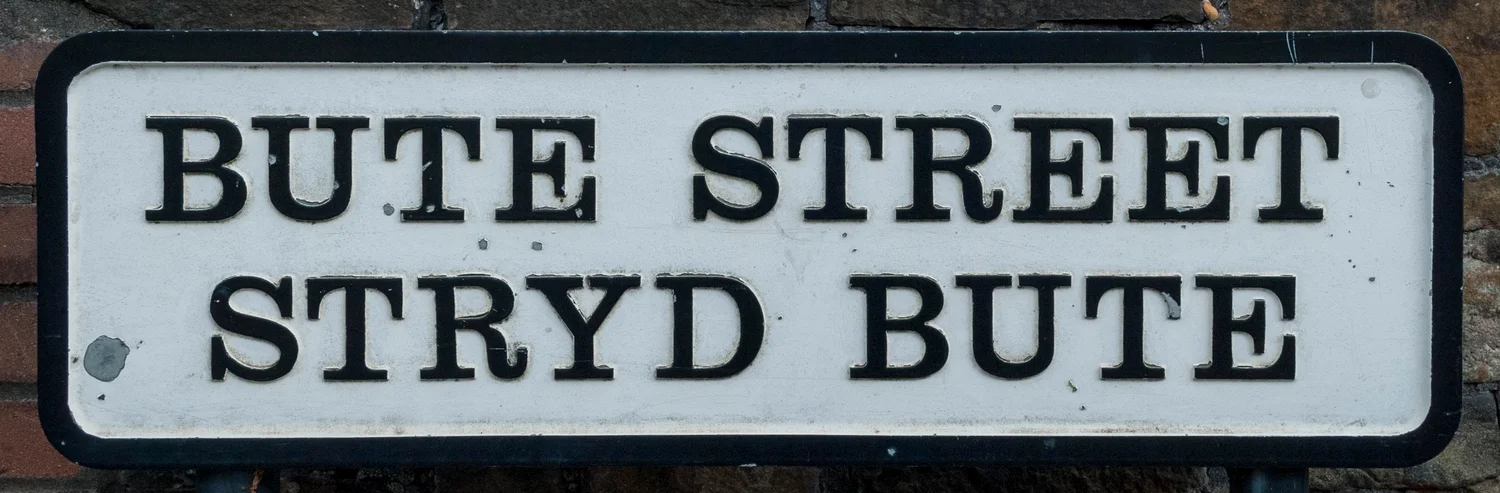
The Cardiff sign has two lines. One gives the English form, Bute Street. The other gives the Welsh form, Stryd Bute. The order of the words changes as well as their language. Both lines stay inside one frame and point out one location. That arrangement does not demand that a person know both before crossing the road. It gives two ways to recognise the same turn, and a reason to expect that the two can be found again in an appropriate record.
Cardiff Council identifies street naming and property numbering as its responsibility and explains how officially recorded addresses relate to services that use them. The Welsh Language Commissioner's code of practice discusses the relationship between names already determined and recorded and what appears on signs under the applicable standards. Those sources do different work. A photograph shows how one plate looked when photographed. An administrative record can show which name or names belong to an address. A general code provides context for why the form on the wall should be tied to the recorded one.
A name on a plate has several jobs
A plate might help a person coming out of a station check the next turn. It might allow a driver to distinguish close parallel streets or a visitor to confirm the end of a route found on a map. Both names should be recognisable at that moment. In a bilingual design the choice of type, line breaks and position can help make clear that these are two forms for one street rather than neighbouring streets on different routes.
A short two-line name can sit neatly in a frame. A longer pair is a harder job. Making one language progressively smaller to fit a narrow space can leave it present but difficult for the people intending to follow it. A sign maker has choices about size and spacing before assuming the language itself is the problem. Put the full paired names in the drawing, as someone would actually read them. Trying the layout with a particularly long pair gives a more useful result than demonstrating that a short pair fits cleanly.
Line order gives a reader one position from which to begin, while grouping the lines gives a reason to read them together. The photographed Cardiff sign is evidence of its particular ordering and style. It is not a specification for every modern sign. If a question concerns current public requirements, use the applicable guidance and local records. The design question the photo makes vivid is how two lines can maintain their integrity while belonging to a single sign.
An address is more than a literal translation
Welsh and English place names can have histories that are not captured by replacing one generic word with another. Even where the two versions of a street name have an obvious relation, the official forms should come from the appropriate authority rather than somebody's guess about spelling or order. A translated phrase that sounds sensible in conversation may not be the recorded name of the street. It is the recorded relation between names that lets different signs and lists give consistent answers.
The Commissioner's code makes a useful distinction between determining names and displaying versions already determined and recorded. That is not the same as a direction to translate every street name afresh. A design team should begin with the official forms for the case. If the record is unclear, it should ask the authority rather than treat the words in an old photo or a mapping product as decisive. The photo can remain reliable evidence of the past use of one plate even when a database answers a different question.
A conflict between a local name and a computer search result illustrates this point. Someone might enter the Welsh form, find no match in a particular app and conclude the plate is wrong. Another person might trust a matching result without checking its location. Both are reasons to compare the app's coverage, the plate and the official address where it matters. A search failure says something about the source and search conditions. It does not on its own rewrite a street.
Make the corner match the route
An easy name to read on a screen may have poor placement on the ground. If a street begins at a junction with multiple directions, a sign needs to be visible from the path people use when choosing the street. Keeping the plate above eye level can protect it from being covered by bodies in a queue. That can also make it hard to read from some positions. The important comparison is between the way records describe the location and how a new visitor can recognise that place.
A fictional example makes the two functions clearer. A person is sent to an event by a map using one form of the name and sees another form first at the corner. A paired sign confirms the relationship while there is still time to turn. The event notice can do the same if it uses the recorded address and gives both forms appropriately. That redundancy helps somebody who does not expect the map and sign to use the same language by default. It can be provided without giving the impression that two different addresses have been listed.
A visitor may still need a number or entrance after finding the right street. A sign with two street names does not replace numbering, a route map or wayfinding to a door within a property. Cardiff's guidance explains why formal names and numbers matter to various providers using addresses. Their jobs make another reason to keep the street label intact alongside the particular building number and location. Two forms of the street name remain linked to one geographic referent.
Keep the paired forms through changes
A useful record lets the two spellings share an identifier without asking either to stand in place of the other. Suppose a municipal asset system tracks several plates at different positions on the same street. The asset identifier can tell staff which physical sign needs replacement. The address record can still identify where the two names point. An issue submitted under either language should make it possible to find both the street and, with a useful location description, the correct plate. Treating spelling variations as asset identifiers would quickly make that work harder.
The photographs in a record have a purpose, but the purpose needs to be stated. A close picture can show the full words on the nameplate or identify damage to its frame. A wider picture can connect the plate to the corner, the position of the neighbouring street and the view an arriving person has of it. Both are useful when a photograph of a clearly printed sign nevertheless fails to resolve complaints about whether it can be found. Reading the sign and locating it are distinct tasks.
A second part of the record concerns the people depending on local addresses in different media. A local history booklet may preserve one naming tradition. A new street plan used to locate services needs to rely on the authoritative current record. It is possible to retain the historical form as evidence without advertising it as the sole current address. If an address was officially changed, an explanatory note can state which version belongs to which date. When looking at old signs, that can be more helpful than correcting an image to lettering it never displayed.
Testing the relationship can be simple. Give two readers descriptions of the same destination, each beginning with one of the recognised recorded forms. Ask whether the information supplied lets them reach the same street and find the same entrance. If one loses the path when moving from map to plate, find which step missed the correspondence. It could be the records, the text of the directions or the placement of a plate that was otherwise accurate. The existence of a bilingual sign does not mean every other part of the journey can be skipped during a check.
Publishing a usable description of a change also helps people remember where a form came from. Site staff can keep a record of which plate was installed at which location and when, so a later photograph does not have to supply the history on its own.
A replacement plate is a chance to check spelling, design and the way the record links the names. Ask which directions of arrival need a visible plate and whether there are other plates identifying the same street. If different records were used at different times, find out why. One photo cannot settle every case, but naming its date and site makes it possible to put that observation alongside the later record. When correcting a sign, identify a legitimate source for the wording rather than trying to regularise it by memory.
The single frame of the Cardiff plate makes a small, useful promise to the person approaching it. Whichever form the reader recognises, the same street is here. Making that promise credible takes attention to official names, legibility and siting, as well as a willingness to treat both languages as carrying actual directions. The plate uses two lines to do one job particularly well.