A Lost Umbrella Gets a Reference
A good lost property service joins two accounts of the same event: an item that was handed in and a person who remembers leaving it behind. Their records usually begin in different places.
In this story 5 sections
A wet umbrella disappears from a bus, in the ordinary sense that its owner has stepped off and no longer knows where it is. Later it may reappear to a driver, cleaner or passenger as an object with no clear owner. Those two events are not likely to take place in the same minute or at the same stop. A lost property service has to keep each account until it can decide whether they describe the same umbrella. The label tied to the object can make the difference between a thing left drying by a door and a thing that has a reasonable chance of being returned.
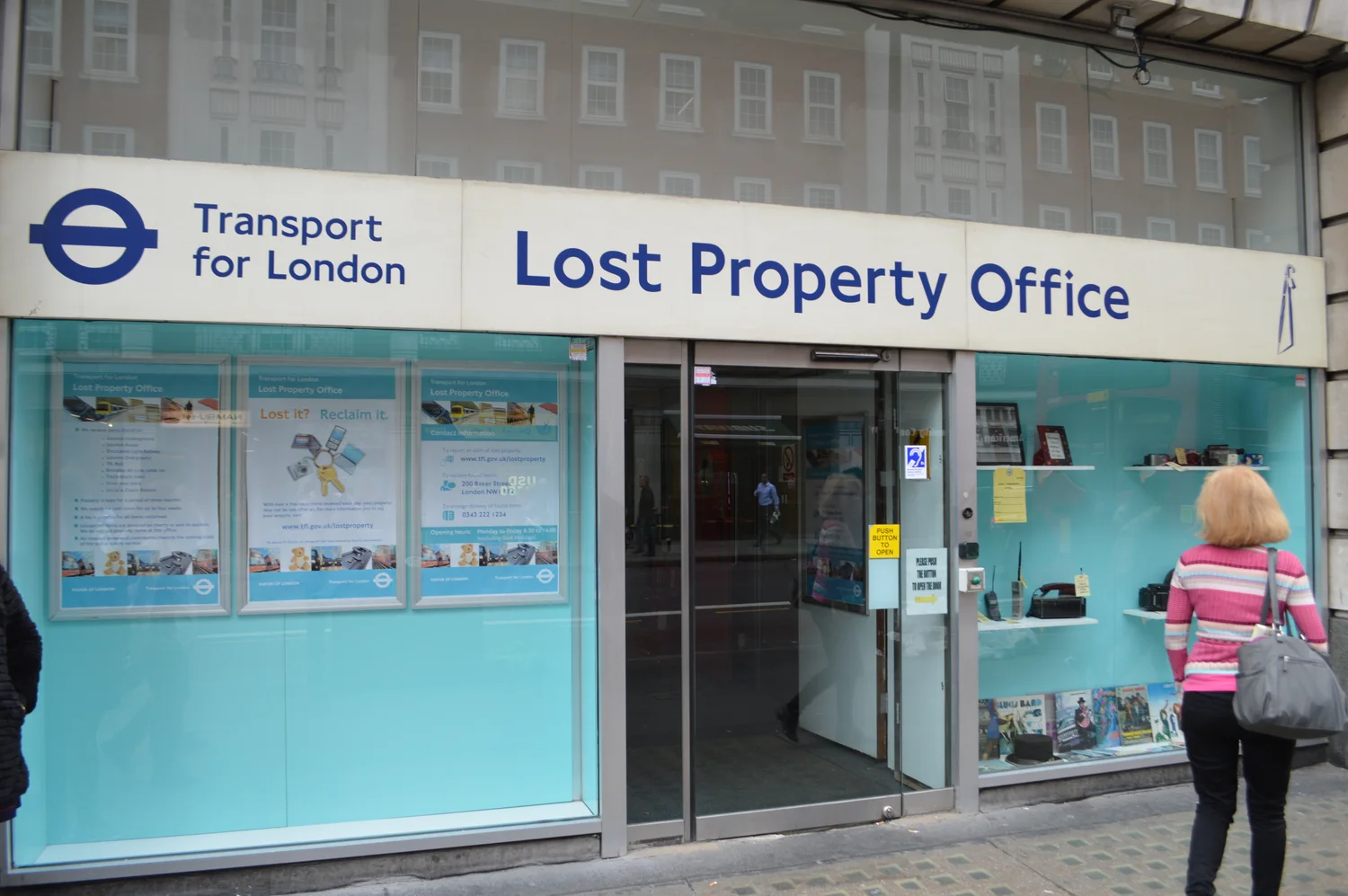
Transport for London describes a system for items found on several of its services, including routes for making enquiries and claiming a possible match. The cover photograph, taken by Matt Brown in 2017, shows a former location of its Lost Property Office rather than current collection instructions. TfL's account of the move to West Ham puts a date on that change. The public face of the service can move while the problem remains familiar: a person trying to recover an item may have only a rough time and a few details to give.
The enquiry and the object are separate records
Take a fictional umbrella left on a bus between two stops on Tuesday afternoon. The passenger can describe the route, the approximate time, where they sat and a characteristic of the handle. The person who finds it may be able to record when and where they picked it up, but not who last used it. There can be two times in the evidence even when everybody's memory is correct. One concerns the probable loss. The other concerns the discovery. Writing both beside the right verbs prevents a search from treating the difference as a contradiction.
A record of an enquiry also needs its own identifier. The passenger may want to add a detail later after looking at a journey receipt or a photo of the umbrella. An identifier for the found object makes it possible to inspect the same article again without expecting a worker to remember a shelf full of similar pieces. If the two records are eventually linked, their original details remain useful. They show why the service considered a match rather than returning the first item with approximately the right colour.
An item can be recorded before anyone asks for it, and an enquiry can be recorded before the item is brought in. Neither absence is strong evidence about what will happen on the next day. A public explanation can say that matching may take time without promising the item will arrive. The person reading it should be able to distinguish not found in a search at this point from no enquiry was recorded.
A bus garage, station and central office work on different clocks
TfL's public instructions distinguish a recent bus loss from items that may have reached the Lost Property Office. It directs people toward the bus operator in certain recent cases. That is an example of a network transferring custody, in which the most useful first contact can depend on elapsed time and mode. It is not a general rule for every operator. A rider should consult current instructions for the relevant service rather than assume the same waiting time or address works across a city.
A description of the handoff can help someone understand why an object found on a train is not immediately at the location they associate with the office. Somebody identifies it, records it and may place it with other items before transport. Sharing the status that can be confirmed is more useful than calling every stage at lost property. The person who can verify discovery is not necessarily the person who can arrange release once the article moves.
The office in the photograph is a reminder that the place people remember can also move. A sign in an older photo may be exceptionally easy to read, and therefore seem authoritative. Keep its date. Follow the current official instructions for the next action, and treat the photograph as evidence of the service's history. The person with an umbrella still on the bus has a more urgent use for that distinction than the person cataloguing the photograph.
Give a description that distinguishes
An umbrella can be blue, folding and wet at the same time as many others retrieved during a shower. Its owner may still know something helpful: a particular handle material, a repaired strap, an identifiable pattern or a mark that usually faces inward. Type and colour narrow the search; a characteristic feature makes the result easier to verify. A photograph already owned by the claimant can be helpful if the official route allows it. Posting all identifying details in public can make it harder to use those details as evidence later.
Details about time should be as specific as the passenger can reasonably make them. If the time is approximate, say so rather than choosing an exact minute. A travel direction and approximate boarding and exit points can be easier to compare with a found report than a single guessed stop. Someone who transferred should distinguish the last time the item was known to be with them from the place where they realised it was missing. Losing an item and noticing the loss are often separate occasions.
The same care protects sensitive items. If something contains personal documents, the service's own form or instructions can say which information is necessary. A reader should not send passwords, full financial credentials or other unrelated details to prove ownership. When an item falls into a category the operator handles differently, the official information is the correct place to check what to do. Reasonable identification and publication of private information are not the same thing.
A return is more than an apparent match
Suppose the office identifies three folding umbrellas matching the broad description. An employee may have to ask for more evidence, check another feature or see whether the time and route narrow the options. Returning something carefully acknowledges a second person who might have lost a similar item. It is more useful to keep several plausible records open than to decide quickly because two of their fields happen to agree.
When a possible match is found, the claimant needs the actual next step and its conditions. The enquiries desk, a place for collecting and a station where something was handed in can be different places. TfL's information describes collection procedures and retention limits and differentiates certain categories of item. Check those details for the actual case. The date of a discovery does not by itself establish that a particular object remains available indefinitely.
A person arranging to collect can keep the enquiry identifier and the instructions together. If the service confirms release, record which item and which handover were involved. This closes the connection without pretending the enquiry, discovery and collection all occurred on the same day. It can also help resolve an innocent mistake, such as two packages set aside for people with similar names. Good records support the person handling the item as much as the person waiting for it.
The sign represents a room full of time
There is value in recording the details that were missing. A finder may not know the exact vehicle; a claimant may have two plausible routes. Neither should be described as certain merely to complete a form. An explicit range of times or a second route can help staff use the information without rejecting a plausible match. There can be more than one partial account worth comparing, especially after an item has passed through several hands.
TfL's report on moving the office in 2023 describes transferring thousands of items to the new premises. That is not a measure of everything the service finds in an ordinary week. It shows that a collection is a physical arrangement that has to be moved, with records still capable of identifying the individual things in it. Without the reference on an item, a perfectly ordered transfer of shelves could make it hard to recover the link to a claim in progress.
A dated public notice can make a move clear from the passenger's side. The value of an existing reference is that it can still identify an enquiry while the place associated with it changes. Reliable contact information and reliable object labels are complementary pieces of the same service.
It is tempting to judge a lost property office by how quickly it answers the phone or opens a form. Those are real parts of the service. Another part is the time between the first observation and a responsible decision about who should collect the item. Staff arrange, store and identify objects that do not naturally present themselves in order. A short follow-up question can save the effort of checking several plausible shelves. A short retention notice can help a reader act while the right sources are still available.
The old office sign gives this work a visible address. The service itself depends on a less visible connection between what was lost and what was found. A bus rider's very ordinary description of their umbrella can provide one end. The label attached after discovery provides another. When the two records meet, it is possible to return the object without requiring either person to have seen the whole episode.