When a Public Pool Shares Its Lanes
Booking a swim, choosing an open lane and finding an accessible way in are three different parts of sharing the same water.
In this story 5 sections
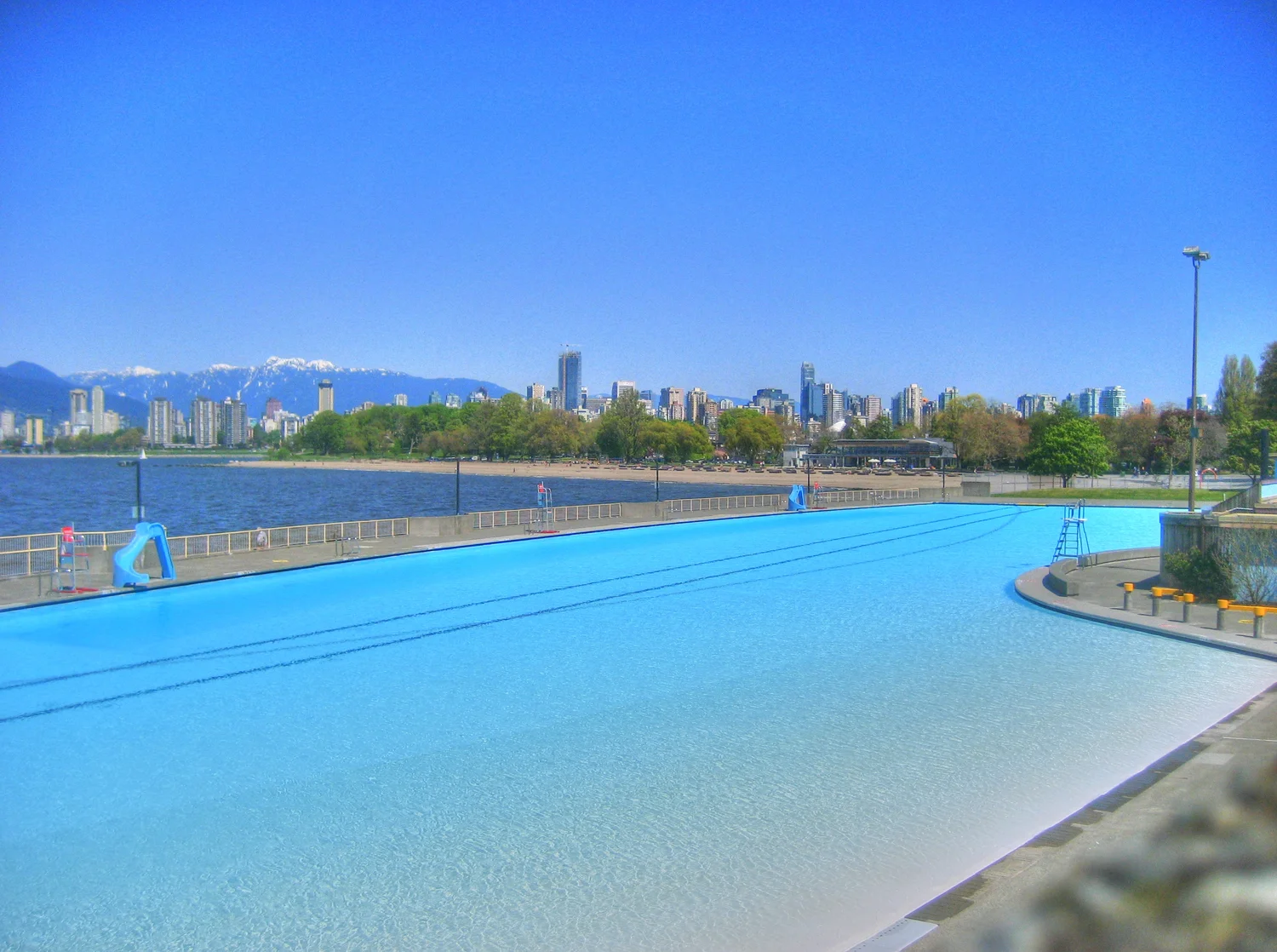
Seen from its deck, Kitsilano Pool looks as if it has a long sight line to almost everything. A stretch of outdoor water fills the front of the photograph. Vancouver and the mountains stand beyond it. The city's published pool description puts its length at about 137 metres, a useful number for anyone expecting a visit to resemble doing lengths at a neighborhood indoor pool. The image shows the space, but someone arriving to swim needs a few pieces of information the camera cannot give.
Is there a place available in the session? What part of the water is set up for lengths today? If a group is already swimming, what is the local arrangement for joining it? Those questions arise one after another. A reservation might answer the first and tell a visitor very little about the other two. A good public pool makes the answers visible in the order in which they are needed.
The timetable describes a session
A pool can be open to several activities over the course of one day without making the entire space available to each activity at once. A length session makes room for repeated journeys from one end to the other. A lesson uses a defined part of the facility for a group with a different purpose. An open swim can give visitors room to choose movements within a more flexible space. Having a pool visible behind a window does not mean that all those uses are possible at the time someone gets to the entrance.
At Kitsilano, the city's official listing distinguishes length swims from other times and has described both advance bookings and places available for visitors arriving without a reservation. These arrangements are specific to the program and can change between seasons. In an indoor example nearby, UBC Recreation lists length sessions as separate activities from other formats and publishes which tanks are available and which length they are set up to offer. The examples illustrate two questions worth asking of a listing: is the session for the activity I want, and how does someone get into it?
A reservation is primarily a decision about admission at a particular time. An empty strip of water may have a different explanation. It could be reserved for a lesson about to start, or closed while staff prepare for a change. Conversely, a group occupying one lane might have room to share it under the facility's rules. For a person arriving for the first time, the front desk is a good point to resolve any ambiguity in the schedule before going out to the deck.
The deck shows the pattern in use
At a facility with ropes between lanes, they keep swimmers in adjacent lanes from having to negotiate space with each other. Within one lane, people may still need to share. At some pools a local rule tells swimmers which direction to travel when the lane is shared. Some designate relative paces or make different arrangements depending on the number of people using a lane. The sign on the deck and the staff member responsible for the session are the sources for the rule in force. A convention learned at one pool can be a poor guide in another.
A speed label works better when it is treated as relative to the people and activity in that water. An individual may have a sustained pace quite different from the speed of the first length. A group might gain speed or slow as a session progresses. Marking three lanes by pace does not require everyone to know an exact time before their first visit. It gives people a way to distribute themselves and a reason to move if the fit between activities is poor.
Other signs have to reach people who may have left their glasses with their bag or may be looking at the deck from water level. Small print set far back from the water can be hard to see at precisely the place a person needs it. Having a pace name as well as a color makes it useful to more people. A sign that says a lane is for an activity can be placed at its actual entry, where the visitor can connect words with a strip of water. Spoken directions still matter, but the arrangement is easier to learn if most choices can be identified before asking.
Make accessibility part of the allocation
A lane or open area can have room while a visitor still cannot get to it by a suitable route. A structure might have an accessible entry to one tank and a different kind of entry to another. UBC's schedule, for example, describes ramp access in some tanks and facilitated lift access in its competition pool. The City of Vancouver lists water wheelchairs and a pool lift among the equipment available at Kitsilano. Those details put admission in perspective. The question is also how a person gets from the entrance to the intended part of the water.
This affects allocation when facilities are busy. A space beside a ramp may be important to a person who could not substitute a lane at the far end. A sign indicating which area is open should correspond to a usable path there from the changing rooms. If staff need time to prepare particular equipment, information about how to ask for it helps someone plan a visit without making them guess what the desk can do.
There can be ordinary practical gaps even when each piece of information is correct by itself. The schedule says lengths are available. A facilities page says there is a lift. The visitor still needs to know whether the arrangement for tonight makes the lift usable for that session. A site can help by offering a clear contact that can answer questions about both the planned program and access. A first visit should not depend entirely on discovering the configuration at the edge of the water.
Changes need a visible point of handoff
Suppose a morning length session finishes shortly before a class that takes over two of the lanes. Staff can work from a timetable drawn well in advance, but a swimmer may be in the middle of a set and unable to see a clock. Someone who has just arrived could reasonably interpret a lane already in use as still open. A sign with an end time, an announcement appropriate to the facility and a clear statement of which areas will be available afterward address different parts of that misunderstanding.
This is true when a planned session is disrupted as well. A brief service change can make one lane unavailable without requiring everybody to leave the building. The website can help someone who has not left home yet; the desk can address the people who have reached the entrance; on-deck staff and signs reach those already inside. A pool with an accurate website and an outdated sign at a lane still has an information problem. Think of the instructions as a sequence that needs to agree from one point to the next.
The staff member watching the water has a job that continues while all these changes are taking place. UBC's visitor information makes clear that lifeguards may direct a question elsewhere while actively observing the pool. A well marked flow gives the visitor a chance to find answers without interrupting that work. It also helps ensure that the remaining questions reach somebody equipped to decide them.
Consider the difference between a sign left in place after closing and a flip board that can be changed at the start of each session. An “open lanes” label without a time may retain yesterday’s meaning. A second field for the active session or the time of the change makes the same instruction easier to trust when the next group approaches.
Decide how much to fix and how much to adapt
An operator could assign every lane the same use for a whole afternoon to make it easy to publish. That arrangement might fit a weekday and work poorly on another day when different groups arrive. It is also possible to change the allocation continually, making it difficult for a visitor to plan. The useful middle ground depends on which things need to be predictable. Long lessons, access arrangements and major boundaries between activities can often be announced. The best fit between people already doing lengths may only become apparent as a session fills.
Imagine a small pool with one more lane of demand than usual at a given pace. A temporary adjustment, if the other water remains genuinely available to the people who need it, may be sufficient. A lasting pattern of crowding at the same time suggests a question for the published program. Short term and long term observations suit different decisions. Good feedback includes the session, the time and which part of the water was hard to find or use. That tells the operator much more than a report that the pool felt full.
Kitsilano's long stretch of water makes the choices unusually easy to imagine. Farther from the camera there is still a real end to it, and there are only so many ways to subdivide it for a session. Sharing works when a person knows before leaving home what activity is available, can find an appropriate way into the water and can see how the space is being used when they arrive. The ropes, signs, appointments and staff play their parts at different moments in that visit.