What Makes a Bus Stop a Place You Can Wait
A shelter, a route number and a place to board all serve different parts of a bus journey. Start on the approach to see how the stop works when people use it together.
In this story 4 sections
There are two ways to arrive at a bus stop. You can find a sign with the route you want on it, or you can arrive at a place where you have time, cover or room to wait before a vehicle comes. The sign and the shelter often happen to be close together. They do different jobs. A traveller with plenty of time and a clear view down the road may be quite comfortable at a pole. Another traveller will need a place to sit, space to keep a buggy out of the way and an unobstructed route to the door when the bus pulls in. It takes more than a roof to make those conditions available.
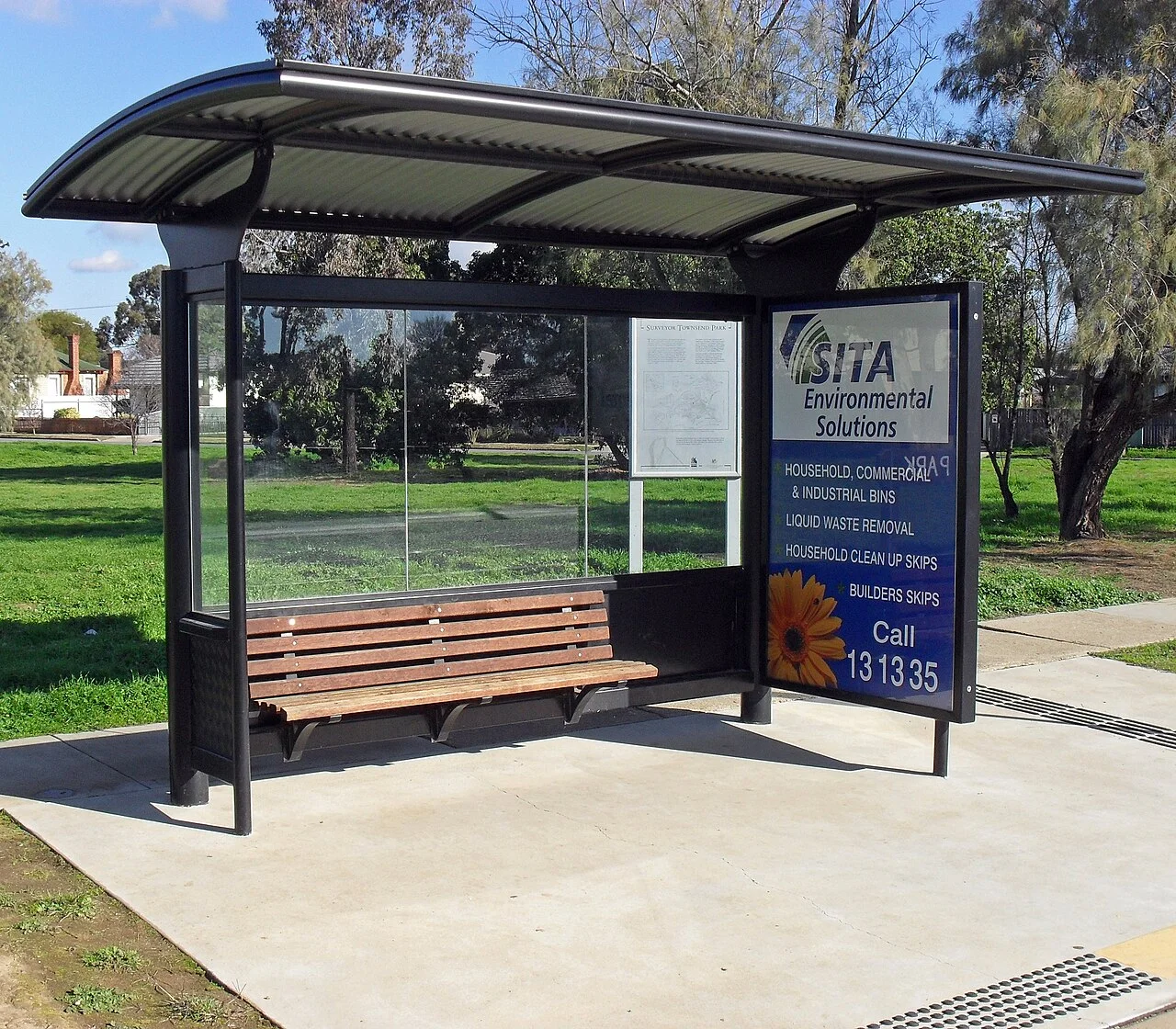
The bus shelter in the cover photograph is in Wagga Wagga, Australia. It is one example of a piece of street furniture that can be recognized at a distance. Design guidance from agencies such as Transport for London, and the NACTO guides cited below, describes different contexts and local conventions. Those publications are useful for noticing how several decisions relate to one another. They are too specific to be reduced to a universal instruction for where every town should put its shelters. To understand a stop you use, begin with the stages of the journey that happen on the pavement.
Find out where the stop begins for a stranger
Walk toward the stop along the route someone might take from a nearby crossing or shop. Try to spot a sign that identifies the service before you are right beside it. Then keep walking until you can read enough to tell whether this is the correct direction. Someone arriving at a stop for the first time needs both observations. A bus number can appear at places on either side of a street, and a direction that is familiar to a local might be named for a destination a visitor does not recognize.
Observe where a person would stop to make sense of the displayed information. A timetable panel can be readable and placed precisely in the path that other people need to use. A printed notice might be set far enough back inside the shelter that a person needs to pass people who have already found seats. Asking where someone stands to read the information can expose a small conflict that is much less apparent when the stop is empty. It can also distinguish a missing sign from a sign present in an awkward position.
A second look from the opposite approach helps here. A roof can be easier to see from far away than the pole and may be perceived as the head of the queue. If the boarding position is separated from it, somebody standing under cover might have little evidence about which way the group will move when the vehicle appears. The stop becomes easier to use if its name, waiting area and boarding point can be recognized in a helpful sequence. A single photograph may give a fine view of the shelter while passing over the moment people discover where to go.
Watch the space with a few people in it
Empty streets tell you how much space exists. A short ordinary wait tells you whether the same space is available for two jobs at once. Imagine one person seated, another standing in front of them, and a third trying to pass the stop on the pavement. Where can each go? If the seats are close to the curb, a person getting up may need to step into the place where others will be moving toward the bus. If people wait farther back, a clear path to board still matters. The arrangement has to work both when everybody is stationary and during the moment they start moving at once.
Observe the line people take past the back of the shelter. There may be an alternative route around it, or the remaining gap may already be the main walking route. A tree, bin or sign can absorb part of that gap. Parked bikes and temporary notices can change it from one visit to the next. People who know the usual arrangement can find another place to stand. Somebody who arrives in the rain, with bags or with a short amount of time, has fewer opportunities to experiment. That difference makes the observed conditions worth recording when reporting a problem.
Seating and cover offer different kinds of support. A person who can stand for a minute might appreciate a leaning rail for ten. Someone using mobility equipment may need clear space next to a seated companion. A roof may cover the bench while doing little for the group forming just outside it. Look at the ground after a shower if it is safe and convenient. Drips, puddles and the direction of spray can put a marked area out of use without changing its dimensions on paper. In hotter weather the angle of the sun may determine which side of the shelter is comfortable while people wait.
At another time of day, look back toward the same information from where people stand. A light can illuminate the bench but leave lettering in shadow, or give a transparent side panel a reflection across an approaching vehicle. A larger type size helps some readers, but its benefit depends on whether the information is placed where somebody can get close enough to see it. Think about the point at which the traveller has to choose between reading and keeping the road in view. A slight change in position can improve both tasks together.
An electronic display, where available, offers an estimate of when a bus might arrive. The static sign still supplies an identity for the stop and may give someone the route they need when the screen is unavailable. If you are assessing the signs, try finding the correct direction with only the information present on site. Then see whether a disruption notice tells you where to go next. Following that second instruction is part of using the stop, too.
The door belongs in the site plan
The bus has to draw close enough to the curb where a passenger can board. If a shelter or advertising panel stands between the waiting area and the expected door, the most practical route may be around it. If other vehicles commonly occupy the space next to the curb, the bus may stop in a different position and the arrangement changes again. Observe where people actually get on when ordinary service is running. A pole can identify the place from a route planner, while the movements beside the curb answer another set of questions.
Where a vehicle has a boarding ramp, it needs usable space at the point where the ramp meets the pavement. This is a good reason to look beyond the outline of the shelter when describing an accessible stop. An area that seems ample by itself may be cut off from the rest of the pavement or blocked by the usual queue. Surface, slope and the way the vehicle approaches can make a difference. Use local accessibility standards for technical decisions. Observations about the particular place still help because the geometry and routine use of the street determine where those standards matter.
You can put the position of the door and the route through the waiting area on a quick diagram without measuring anybody or recording faces. Include the space needed to get from the public pavement into the waiting area, then onward to the door. Mark the passersby’s path as a separate line. The places where the lines cross or come close are usually the places to revisit with a street designer or transit operator. People using different routes may describe different obstacles. The diagram simply provides a common point at which to look.
Make a report someone else can act on
When a problem is recurring, note the stop name or number, the direction served and when you saw it. A photo taken from the end of the approach can show the sequence from street to information panel to waiting area. A second view toward the boarding edge can show why a person has to go round an obstacle. If you are describing a time when a bus could not reach the curb, report the circumstances you observed rather than drawing a conclusion about every trip. The observations make it easier to distinguish an issue with the furniture from one with maintenance or operation.
It can also be helpful to record what already works. A good shelter position can leave a necessary line of sight to approaching vehicles. An opening in a nearby fence can provide a direct route that appears unimportant on an isolated plan of the stop. Moving an object could resolve one conflict while closing off a route people already use. A report that includes the practices it hopes to preserve gives the next person a better problem to solve.
The whole trip appears in a few minutes beside the bus sign: a person approaches, identifies the service, finds a place to be, and moves to a door. Each stage can be helped by a specific design choice. Seeing the stop in that sequence keeps the most attractive object on the pavement from getting all the credit, and keeps the people who need to wait from disappearing from the picture.