A Sign for a Quiet Carriage
A train can set aside one shared space for quieter travel. The sign for it has to help people choose a carriage and understand what quiet means once they take a seat.
In this story 5 sections
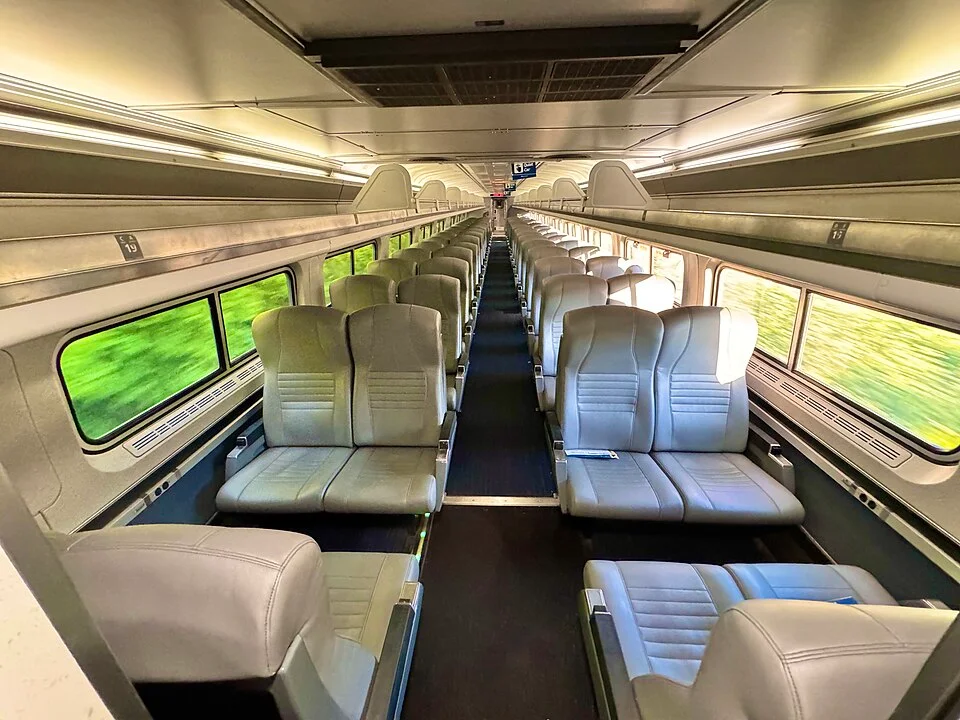
From the aisle in Harrison Keely’s photograph, one can see how far a voice might travel. Two rows of seats reach toward the far door. There is no partition between the seats closest to the camera and most of those beyond them. Windows reveal a bright landscape, and the tables and overhead racks look as they could in many passenger cars. The photo record places this carriage on Amtrak’s Vermonter in 2024 and identifies it as a quiet car at the time. That historical identification is not a statement about the amenities on the current Vermonter timetable.
A quiet carriage takes a familiar travelling space and asks people to use it in a particular way. The same seats still have to serve people boarding at different times, people travelling together and passengers who might need assistance. The carriage keeps moving, doors open and close, announcements remain necessary. A promise of complete silence would describe a different room. The service depends on the smaller promise of fewer avoidable sounds, and on making that promise apparent to the person about to step inside.
Say what people can do
A sign that just says quiet leaves quite a lot for a traveller to decide. Is a brief greeting fine? Can someone answer the phone and talk softly? If audio cannot be heard by the person in the next seat but is clear across the aisle during a pause, who notices first? Amtrak’s published Quiet Car guidance distinguishes these activities. It asks people to speak softly and reduce conversation, prohibits phone calls and asks people using personal devices to listen through headphones at a volume other travellers cannot hear. These are descriptions of behaviour. They are easier to act on than an invitation to judge whether each individual considers a noise loud.
The listener's position matters. A note kept very brief by its sender may still interrupt the reader behind them. A person holding a familiar device can underestimate how clear its speaker is across a quiet row. The words on a sign can give people a normal test for their part in the space: others should not be listening to the same thing. Shared expectations let someone choose to use a different car if they expect to take calls or talk at length. This need not imply that one audience is a better kind of traveller. They are making different use of the same journey.
A train is not built out of quiet and noisy people. The same person may want to talk to a companion on the first part of the trip and read on the second. Choosing a seat is an immediate decision about fit. Staff still need to give ordinary safety or trip information and help travellers. A useful set of reminders leaves room for that activity, so the sign doesn't make necessary conversation sound like a breach of the shared agreement.
The useful sign may be the one outside
By the time a passenger has reached a seat, they may have lifted a bag into the rack and sat beside someone who has already made room. Discovering the car's arrangement at that point makes a change of mind costly in time and effort. The person might have to get up, carry the bag through narrow passages and find another seat. A small visual cue on or near a door can prevent some of those awkward moves. The best place for the cue is one where a person can see it while they can still act on it.
Amtrak’s guidance refers to a Quiet Car symbol on selected trains and directs uncertain passengers to the conductor. The use of a common symbol makes sense alongside words. A symbol is quicker to recognize after someone has learned it. Unfamiliar passengers still benefit from language identifying the space. The direction of travel and the design of the car decide where a cue can be seen. An exterior sign may help a person standing on a platform, while a reminder near an interior entrance may help a person already aboard. The same car may have an approach at either end.
One can judge the sequence by walking it, at least in imagination. A traveller gets off stairs on the platform and sees several doors. At the first relevant door they can identify the quiet space or learn where to ask. Once seated they can check the exact expectations without standing to read fine print. If they need to move, they should be able to tell whether the arrangement applies beyond the next door. A small sign on the back of one seat could help with the second stage without doing anything for the first.
Allow for changes without making everyone guess
People learn where quiet carriages usually sit on a route they take frequently. That knowledge can work until the composition of the train changes or a passenger boards at a station served by short platforms. A fixed direction like look for the rear car is useful only where that arrangement applies. A label attached to the relevant carriage or a clear message from staff can close the gap on a day when ordinary assumptions fail. A published service page can set expectations before travel without treating an old picture as proof of what's there today.
There is also a difference between finding the car and getting a seat in it. Amtrak describes different seating procedures for its Acela service and its other Quiet Cars. On a train where people choose their own places, someone can find the correct carriage when it is already full. Where a seat can be selected in advance for the applicable service, the arrangement may be part of a choice made well before boarding. Either way, the service description is more useful if it says both whether there is a quiet car and how access to a seat there is determined.
At busy times a passenger may sit in the only space available. A policy that relies solely on voluntary discovery while people board invites misunderstandings. Someone might comply happily if a reminder reaches them early. If remaining quiet is difficult because of an immediate circumstance, clear advice from staff will usually give them more practical options than expecting a discussion among strangers. A public service has to keep working when the original ideal of free choice among several seats isn't available.
Staff can help the sign mean the same thing all day
A quiet carriage can have stretches of relaxed use followed by many new arrivals at once. With the change in occupancy the same rules have to be made understandable to people who weren't there for the last reminder. Clear, neutral wording gives a staff member a way to refer to an established arrangement without making it personal. It also gives passengers a reference independent of what the person next to them happens to believe. There is a difference between enforcing a stated limit on phone calls and expecting one passenger to win an argument with another about their ordinary voice.
Train sounds are part of this room. Wheels, ventilation, doors and on-board announcements are not easily changed by a person taking a seat. What the rule asks them to change is more limited. Where an announcement repeats the quiet guidance, it may briefly add sound while reducing a source of longer interruptions. A reminder delivered before the carriage fills can work differently from repeated individual instructions once the aisle is crowded. The choice of time belongs to the service as much as the choice of words.
Accessibility belongs in the same discussion. One person may rely on an audible announcement and another on something they can see up close. A text label and a recognizable symbol help at different distances. An important route announcement remains important in a quiet space, just as a traveller still needs a way to request assistance or communicate essential information. The point of the arrangement is to make the journey calmer for people able to use it, while carrying those ordinary responsibilities along with the seats.
Pay attention to where a quiet zone ends as well as where it begins. An interior sign that marks the end helps someone find a suitable place to talk once they step through the door. The space just outside might still be a passage people need to keep clear. Good directions help a passenger move to a seat or area where talking is permitted and practical, instead of leaving them to stand in a doorway while others are trying to get past.
Read the next row
Look down the aisle in the old photograph again. From this position several dozen people could appear to be doing different things in the same shared space. Some could be reading, others looking out of the window and a few waiting to board or leave. The shape of the car makes the consequence of a single decision easy to picture: holding a call at one seat might be audible in a number of others. No decorative change to the seats is needed to show why that matters.
The strongest sign is one that makes that shared situation readable before a traveller has to negotiate it. It helps them locate the space, gives examples of what the agreement covers and says enough about where to ask if something changes. People remembering a remarkably calm trip are likely to remember the window and the long view along the aisle. The small symbol they passed to get there did its job by making the arrangement easy to understand early enough to choose it.