An Hour on a Public Tennis Court
A public tennis court can make room for reservations and spontaneous play. The practical test comes when people arrive, see the same court and have different ideas about who can use it next.
In this story 4 sections
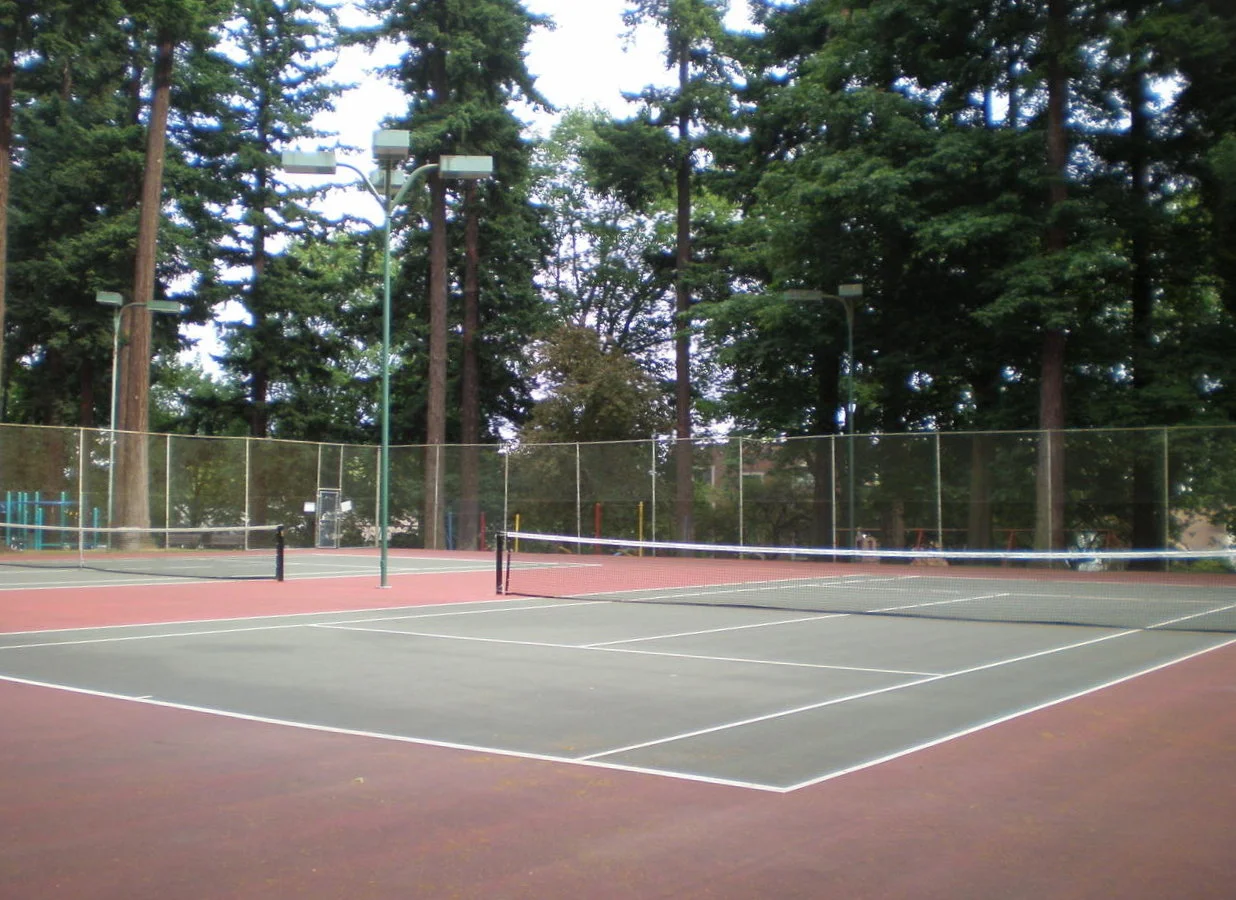
At a public tennis court after work, four people wait outside the gate. The people inside seem to be close to finishing. One of the pairs outside thinks it will be next because it has been there longest. Another has a reservation for the coming hour. Both can read the lines on the court and know what makes it a court rather than a larger rectangle of paving. They need another kind of line to tell them how the time belongs to people. Without clear information they may be about to negotiate something the parks department thought it had settled already.
Portland’s parks department describes a system with neighborhood courts and larger places that accommodate different kinds of tennis. It offers information about court locations and about reservations or activities, as relevant to the site. Arrangements vary, and the photo of older conditions at Laurelhurst Park is an illustration, not an account of a present reservation rule. A person planning to play should check the information for the actual location and time. For someone trying to understand the design of a public service, the worthwhile question is how any policy becomes comprehensible to the two people who arrive with the same equipment and different expectations.
The occupied rectangle is one resource
A tennis court can only hold so many compatible activities at the same time. For an uncomplicated example, take two courts in a park with distinct gates. Make five blank hours on a piece of paper for each. One hour on one court is a convenient basic slot for planning. It does not necessarily represent sixty uninterrupted minutes of actual play. Turnover, weather, maintenance and the demands of setting up some activities can use part or all of the scheduled availability before a ball is hit.
Now mark one court as reserved for a class in the middle of those hours. The other court can still offer play and the first becomes available later. A label at the main gate saying “courts reserved” without distinguishing them would turn a booking for part of the site into an apparent restriction on the whole site. An online schedule that identifies “court 2” without putting the names on the gates poses the opposite problem. The schedule is specific, but the person using it lacks the last piece of information to apply it. Numbering and location are decisions about access as much as about tidiness.
The number of usable courts can change. A net might be unavailable, wet leaves might make one part unsuitable, or scheduled maintenance might reduce capacity. A reservation recorded yesterday should not force a visitor to assume the physical condition is fine today. Clear information can show what should be available and how to check for changes. Someone who would have made other arrangements using that information may be glad to know even when the message is bad news. The absence of a clear message usually does not preserve a place for them to play.
Two ways to reach the same hour
A reservation offers some certainty in advance. Someone coordinating several people or coming from some distance has a reason to value it. A walk-up arrangement allows a person to fit play into a free evening without knowing in advance whether they will have one. It can work well when there is enough space and a shared way to settle waiting. Neither way of providing time suits every visitor. An explicit mixture can be useful if people can tell which courts or periods belong to which arrangement. A mixture communicated by hints and old rules can make each group think the other is breaking a promise.
Consider one hour at a fictional busy court. If it is reserved and the pair running late does not appear at the start, the people waiting may each have a different idea about when it becomes available. A local policy might specify some period or require a check. No general cut-off can be assumed from another park. If the policy depends on something visitors can reasonably observe, such as an updated court schedule or a specified point of contact, give that information a clear place. An instruction that needs five things on a phone is not much use to someone who only saw the hours at the entrance.
Likewise a first-come arrangement needs a way to handle people already playing. A limit or a norm for giving others a turn has very little value if the next group cannot tell whether it applies when nobody is waiting, or when the next court is free. Check the wording against an ordinary case. Who talks to whom? Which court does it concern? What time will the decision occur? These questions need answers simple enough to be read and acted on at an entrance, not a full explanation of how every program uses the site in every season.
Walk the whole path from information to play
Imagine a group that reads the park’s information online and decides to go. Upon reaching the court they still have to identify the right gate, see the intended directions and find space for things they are carrying. There could be a clear barrier around the court and no useful space for a person waiting beside a path. An arrangement that seems fair on a booking page has a different effect if some visitors have trouble getting to its starting point. Access is a property of the whole sequence. It does not become irrelevant after the schedule displays the desired time.
Look for the place at which a conflict would first become visible. It might be a court number that is readable only from inside, or an unmarked shared path whose users inadvertently block the entrance. It could also be an older sign left in place after a policy changed. Note what a person looking from the usual approach could actually read. Where a solution depends on moving one notice, it may be more useful to move the notice before writing a better description for a site no visitor expects to consult on arrival.
Another issue concerns people who want different kinds of space. Programs might share or rotate use across sites, and a painted layout can support more than one use depending on the rules and installed equipment. That is a reason to keep the current location and activity information together. There is no need to infer a general priority from the way the markings happen to look in a photograph. A public authority should make clear which possibilities it intends to offer in that place. An observer describing a conflict can say which arrangement people believed they were using as well as what the ground looked like.
Write a hypothetical weekly schedule with one court assigned to a recurring lesson. Compare it with a schedule that places the same lesson on both courts for half as many hours. The total used court-hours can look the same. The first leaves one court open to other use throughout the lesson, while the second creates a complete closure to other play for a short period. One lets a local group risk walking to the court; another asks them to arrive outside a short time window. Maintaining the same total hours is not enough for the two arrangements to serve the same people.
If a program tries one arrangement for a limited period, put the dates on the notice and plan how the public will learn what happens next. A visitor who comes every few weeks may otherwise find the trial rule only after it has been withdrawn. The record of a trial should include what people could actually see at the time as well as what was intended.
Learn more than the count of occupied courts
A city looking at a popular site might count occupied hours and find a relatively busy feature. Another count might show which kinds of use waited or left before there was room. Those values do not measure the same thing. A packed hour can be quite successful if many people get a useful turn. It can also be an hour during which the same group had very few chances to let somebody else share. Observing what happens at the gate gives a question to ask of the totals. It cannot substitute for a count across appropriate times and conditions.
One simple review is to compare a scheduled activity period with an unreserved period and take notes from a safe public place. Record how many courts appeared available and what visitors could find out about the next hour. Include what was difficult to tell, such as a group you could not see from the gate. Measures of actual demand, equitable access or unmet need require additional evidence. Even a modest report can identify an unmarked court or an unclear rule that should be fixed regardless of how those broader questions are answered.
Walk back to the fence where the two pairs arrived. There may be a reservation to honor or an agreed way to take turns. The success of the public arrangement lies in making that relationship clear while both groups still have useful choices. On a map the court is a small green shape. On a busy evening it is a place that depends on someone writing down how people may share the same hour and making that information easy to find where the hour begins.