The Number Above a Market Stall
A market directory has to connect names, products and locations. Barcelona’s Boqueria makes a useful starting point for thinking about the small signs that help people share a busy hall.
In this story 5 sections
A sign works differently at the front of a market and ten steps inside. At the front, a broad entrance and one recognizable name can be enough. They tell people this is the building they are looking for. In an aisle there are competing signs, displays and conversations. Someone may arrive with the name of a shop but have no idea which row to try. Another person might know exactly what product they want and not care whose name is above it. Less prominently, a small printed number may identify the space itself. The trade names and the space numbers each do a different job.
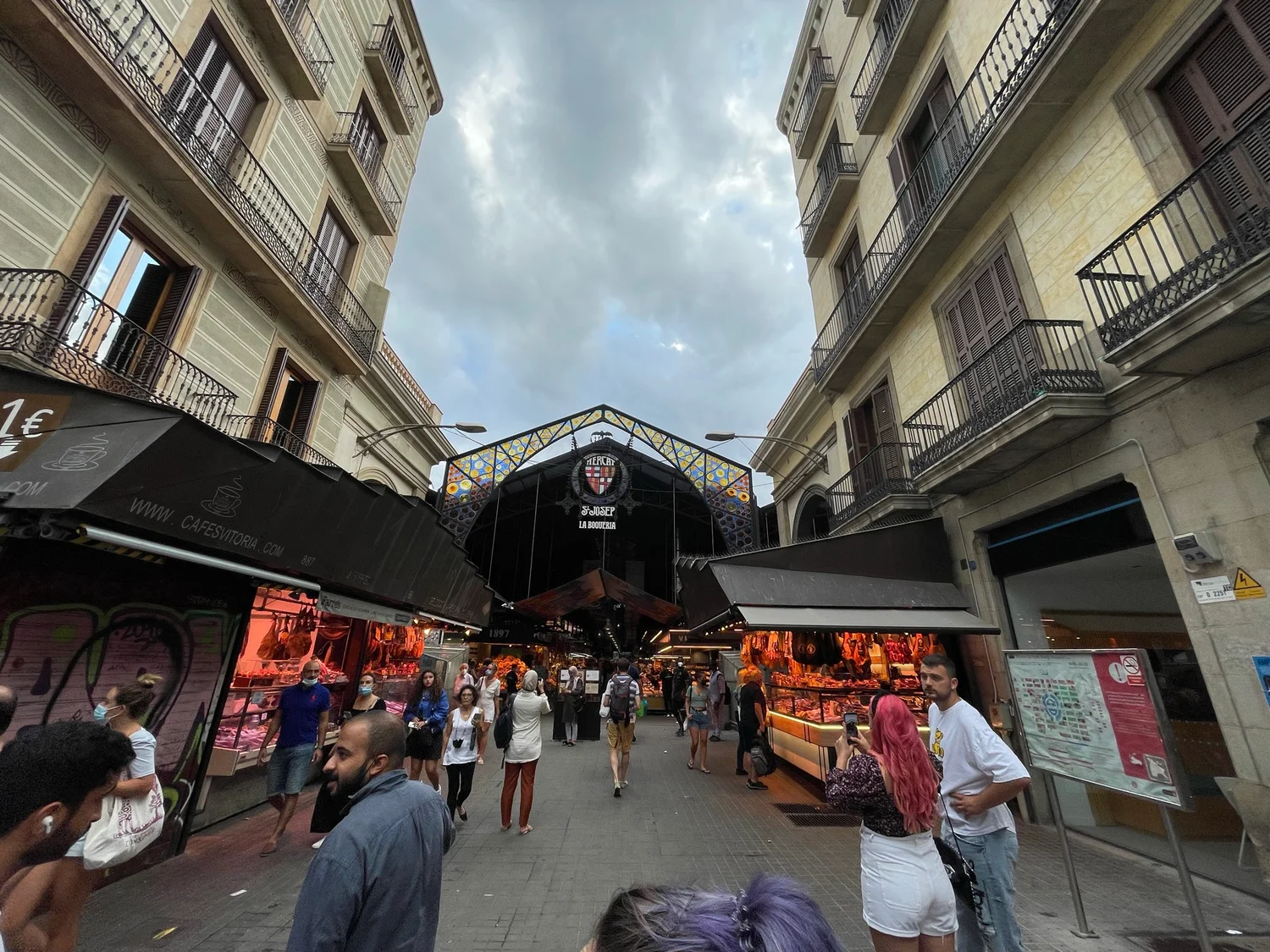
Bxalber's photograph of Barcelona’s Boqueria takes that first, outside view. People are moving under a broad entrance into a deeper and busier hall. The Barcelona History Museum traces the start of construction at the former site of the Sant Josep convent to 1840. That helps to situate the building in the city's long effort to organize food supply. The present market's online directory supplies an equally telling piece of evidence about how it works: a visitor can look up a shop by name or stand number, or begin with the kinds of things sold there. This is how one street address turns into many small destinations.
Three questions at the entrance
A name is useful when someone already has it. A neighbour has remembered the shop written on a paper bag; a visitor has a recommendation from a friend. Ideally the spelling on the bag matches the spelling on the map. Abbreviations, accents or a mark painted on the shop front can make the two seem different. Local knowledge bridges the difference easily. For a first visit, it is the directory that has to connect the two. A number can help when the name is hard to hear across a crowded hall, but only if whoever gives it can say where to start looking.
A category serves a different visitor. Someone may want vegetables, nuts or fish without having thought about which stand to visit. The official Boqueria map makes categories like these visible. A category can direct somebody to several options. It cannot necessarily say which is nearest from the door they used, whether a seller has a particular item or which approach is easiest with a shopping trolley. A search result can stay useful without pretending to settle those questions. It needs to give enough context for the person to take the next step.
A stand number has a narrower meaning. It can say which place in the premises is meant even if the business has closed for the day or there is nothing displayed out front. A reliable number can be passed among people who need to meet at that point. It is effectively a small address, one that not only customers might use. A shop may be described three ways on three different documents, and each description can be correct: a sign gives its trade name, the map gives a category and a building record identifies the unit.
Help people find the first turn
A directory is often easiest to read when the area around it is quiet. In a market the moment of choice often happens amid queues and movement. It matters where a person can pause without blocking the entrance. It also matters whether they can look at the map and then see a sign in the real aisle that confirms the direction. An arrow can mean turn now, or go straight until the next crossing. A row marker at the crossing makes that distinction easier than a more elaborate key on a board still back at the door.
Imagine someone looking for a stand called Cedar, a fictitious example. A directory gives it the number 32. The next visible sign marks stands 20 to 29 to the left, with one label pointing farther ahead. Without knowing what the market sells, the visitor can make progress. If their route goes past a space labelled 35 before encountering 32, it may signal that numbers run along both sides or once followed an older arrangement. A row name and a near landmark can do more good than expecting a visitor to infer a perfect sequence. The system can remain usable without renumbering long-standing spaces every time the floor changes.
A map becomes even more important when the main entrance is not the one a person uses. Somebody may arrive through an adjoining lane, or may look for a route that avoids an obstacle. A map with a marked starting point but no other landmarks can send a person in the wrong direction if the picture was drawn from a different door. Naming key entrances and placing signs so they can be read from each approach helps the same guide work for people arriving from different parts of the city.
A route is more than a line
Deciding which aisle to use becomes harder when the easiest path on the plan is not the easiest in the room. A line between stalls may be narrow where there is a queue. A door with a step may be useless to someone who needs a level entry. Others might be looking for somewhere to rest before continuing. A directory can include useful information about access without making a universal promise about conditions throughout the day. Mark where a route begins, indicate where there is a level alternative if there is one and identify which desk can answer questions about changes.
Some visitors rarely use a market's online map. A sign at a comfortable height, whose words and symbols are meaningful as well as its colours, can carry information without asking for a connection or a phone. An online guide still has a role. Somebody could check the route before leaving home, or enlarge text that would be too small to read on a printed board. The most effective arrangement keeps the same names and numbers in both places. A link to a digital guide cannot rescue a sign whose only direction tells a person to look for a stand number the guide no longer uses.
People should also be able to give directions to each other. “Two aisles beyond the entrance with the big arch” is more stable than “after the stand with the oranges” if the display changes with the season. The human version and the graphic version can support one another. Landmarks that are permanent enough for a map are also good candidates for everyday speech.
The same room before the doors open
Customers need routes during opening hours. A person bringing supplies or dealing with a building issue may need a place identified when the doors are shut and the stalls are covered. A number fixed to a location continues to identify it without a bright display or a merchant to answer a question. That is why decisions about numbering often concern the operation of the premises as well as shopping. A map for a delivery or maintenance team might say where to enter or how to find a particular service area. It doesn't have to put that information on the customer-facing plan.
Now picture a section of a market being refurbished. For a short time a few trades may use other pitches. The original number will still be meaningful to the person working on the space, but it will lead a visitor to a closed counter. A temporary notice on the old site can point to an aisle or a pitch used in the interim. The change needs to reach the entrance board or directory too, with an indication of when it applies. A person searching a trade name should be able to find the business while a person searching the original number can still find out what happened to it.
A market may be tempted to leave the digital change until the physical work is over. On the days when customers are most likely to look up unfamiliar directions, that delay would preserve the problem the guide could solve. Small updates have much more value while the new pattern is unfamiliar than once everybody has learned it.
Leave a trail a stranger can check
A good way to read any market map is to see whether it permits a sequence of checks: identify the building, identify the right entrance, choose a row, recognize the stall when it comes into view. A person who misses one of those cues should be able to recover before reaching the opposite side of the hall. Under that test, a market photograph and a directory offer different information. The photograph gives a sense of how a public room meets the street. The map gives a visitor somewhere to aim once the roof is overhead.
A worker who uses the room every day will almost never have to make all those checks. They know which passages meet, whose display will be where and which route works when a queue forms. A newcomer has to borrow a portion of that knowledge in the form of a sign, a number or a spot on a plan. The information at each stage can be modest. Put it in the right place and keep it up to date, and the person can find an ordinary destination without having to learn the rest of the market first.