The Barbecue That Belongs to the Park
A public barbecue is a fixture several groups can use in the same afternoon. Its placement, rules and upkeep are what make a small shared cooking space work.
In this story 5 sections
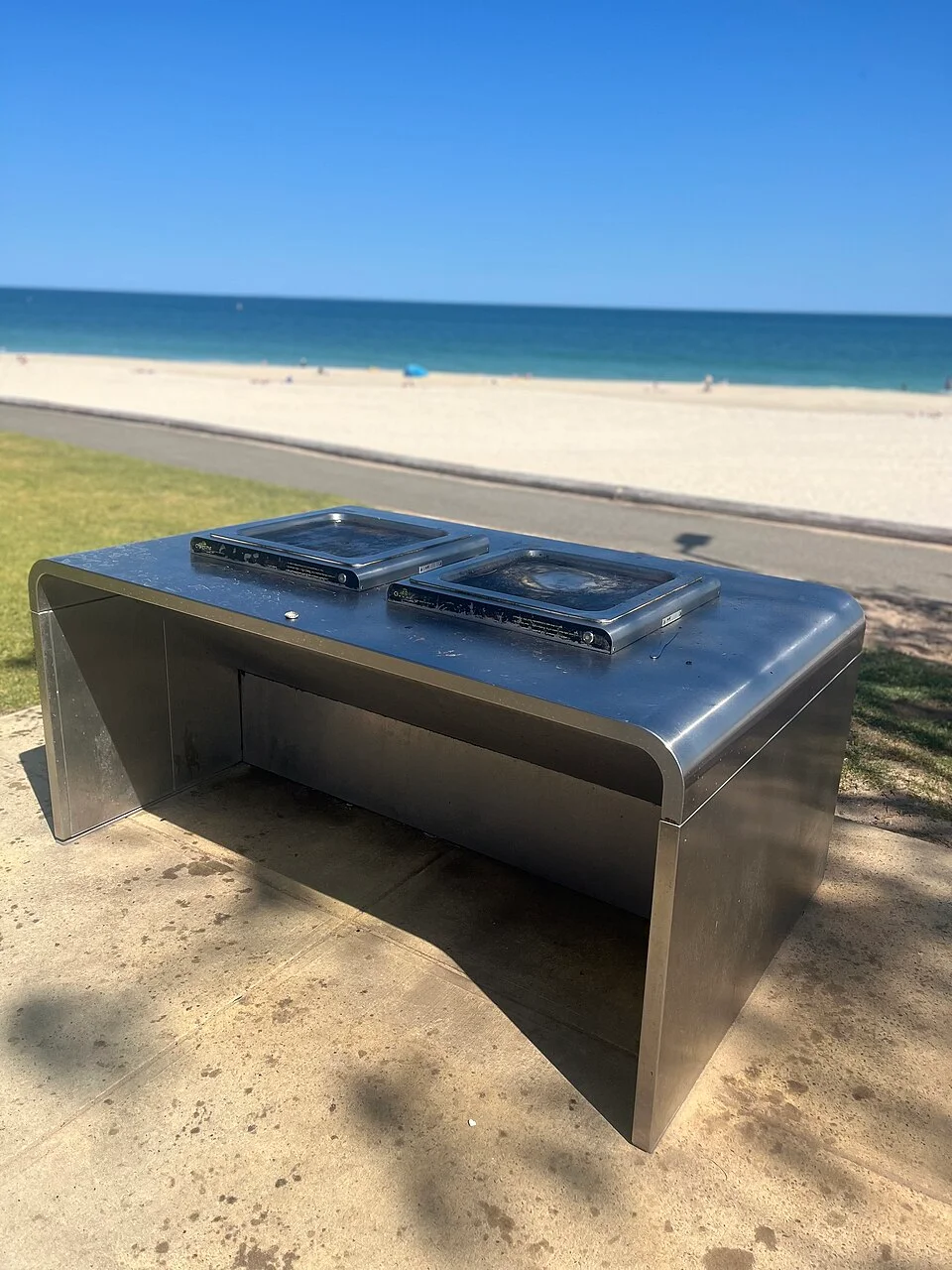
The stainless steel fixture in the photograph faces a broad stretch of lawn and a much broader stretch of water. It is a public barbecue at City Beach Park in Western Australia. Looked at as an appliance it has a top, controls and space for somebody to stand. Looked at from the lawn it is one part of a larger shared arrangement. A group may occupy a table some distance away. Another group can arrive while the first still has something cooking. The space has to accommodate those movements without asking everyone to belong to the same picnic.
The Town of Cambridge describes barbecue and picnic facilities at City Beach and at other local parks such as Beecroft Park. Their appearance in a public facility list says that a visitor can expect to find that kind of installation. It does not necessarily provide every use condition or establish whether a particular plate is available right now. Those are different kinds of information. A useful description takes the visitor all the way from deciding where to go to knowing which part of the space they can use.
The table and the cooking surface may belong to different groups
A public barbecue can sit beside picnic tables without making every table part of a reservation. Picture two groups arriving at different times. One finds a table, while the other is already using the cooking surface. Neither may know what the other arrived first to use. If an operator has formal rules for the arrangement, they should be visible before an argument starts. Where use is informal, distinct names for the areas and enough room to wait help separate the two needs.
The walk from a table to the appliance can shape what happens during a busy afternoon. A route that crosses active play space can be a conspicuous inconvenience. If serving and waiting take place on a narrow path used by everyone else, people who never planned to cook have to work around the setup. The position of the fixture is thus a choice about movement as much as proximity. The most useful equipment on a plan can become hard to live with if there is nowhere to stop near it.
A park with several fixtures can still have uneven demand. One may be beside shade, shelter or a well used cluster of picnic tables. Another may be farther from the view or from the entrance. Counting both as equivalent tells a planner how many assets there are, but not how waiting is distributed. If one area is always crowded while a second is overlooked, a clearer wayfinding sign might matter before a new appliance is considered.
A short notice can explain the extent of the service
A prospective visitor does not necessarily know whether barbecue facilities means built-in equipment, a place to use portable gear under stated conditions or both. The associated rules can differ with the site and conditions. A page intended to guide a visit can name what is provided and send the reader to the authority's current rules for the rest. The existence of a built-in fixture should not be taken as permission to bring another appliance or fuel to a site.
There can also be two levels of instructions at the point of use. One set relates to what the visitor can do on this particular fitting. The other relates to sharing the broader space. A single sign can become hard to read if it tries to give operating directions, rules for reserving a shelter and a general park map at the same scale. People walking from elsewhere can use the location information at a distance. People standing next to the plate need the relevant instructions there, even if they did not see the web page.
It is worth giving the facility a distinct name or number on a maintenance map. If someone calls to say a fixture will not operate, a park name may not identify the unit. A short description of what was observed and a nearby landmark can help where no visible identifier is available. It is better for the service to explain when more information is needed than expect a visitor to guess at the condition or repair of an appliance.
What a visitor can reach is not just a question of height
For a shared facility, a person may need to reach a control, stand or position a mobility aid and retain access to a place to set things down. A fixture drawn from the front can look open while the side people need is blocked by a curb or another object. A site plan should include the usable approach and surrounding space. The barbecues at City Beach can be located in a list of amenities; the photograph makes it possible to see at least part of the setting around one. Neither replaces a current assessment of access for a particular visitor.
A group can use a place as several small systems at once. One person remains at the picnic table, another collects something and a third looks after belongings. If the space between them is inaccessible or hard to follow, the common label barbecue area does little to make their visit easier. An accessible path, suitable surfaces around equipment and nearby space to wait may matter even if the equipment is exactly what the list promised.
Think of a visit ending. People leave bags and temporary items on nearby surfaces while gathering them up. A new group is already standing at the edge. The facility must remain usable at the point of exchange. Paths and arrangements that appear generous when vacant can narrow substantially in that moment. A visit to the park during ordinary shared use can reveal more about the room around the fixture than a carefully cleared promotional photograph.
Maintenance is a form of sharing space too
An operator needs a way to inspect the fixture, see whether a report names the correct equipment and communicate any temporary closure. Visitors need to know what the space expects from them before they leave it. These are different responsibilities. An unreadable notice cannot turn a broken unit into a working one. A functioning appliance near a littered table may still be an unwelcoming shared place. Clear information about what belongs in the public area and a realistic inspection plan help future users inherit something they can use.
An availability notice is most useful when it can identify what is affected. Suppose a small park has two plates and the one beside the shelter is out of service. A sign that says barbecue closed may be accurate at the fixture while confusing on a notice that names only the whole park. If the operator confirms another option, state which. If availability has not been checked, state that clearly rather than create another destination that turns out to be unsuitable. People can adapt a plan only as far as the information goes.
Start at the edge of the lawn
The surroundings also determine which other public uses the cooking area can share comfortably. A bench facing the sea might provide room to stop briefly without putting belongings in the space needed to operate the fixture. A nearby picnic shelter can be useful in unsettled weather and can draw waiting people away from the direct route to the beach. If the facility is in a busier setting, a simple separation between the path through the park and the route to the tables can have a larger effect than adding another appliance in the same constricted place.
Compare the two parks named by the town. The description of City Beach groups the facilities with a beach and lawn; the description of Beecroft includes play facilities in a treed reserve. The local pages tell us that both offer a barbecue, though they describe different settings for using it. A short stop on a day near the water and a longer gathering beside a playground can place very different demands on approach routes, tables and waiting space. A list of available fixtures is helpful before visiting. It is not a reason to assume the same placement decisions make sense at both parks.
Finally, remember people who use the lawn without coming to cook. They may pass the area on the way to the water, push a stroller past it or sit briefly with no plan to stay. Their experience is one way to tell whether a public facility has been given enough room. A plan that needs every passerby to understand an informal queue has probably put too many decisions in the same small space.
The appliance in the picture looks compact because the beach and sky around it are so open. The compactness is honest about the machine and misleading about the service. People need a route, space for bodies and belongings, an understanding of how to take a turn and a reasonable prospect that the fixture is ready. Those needs extend well beyond the metal outline.
A drawing of a successful shared cooking area can begin at the nearest path and end with the next group walking over. Mark where people stop to read, where they wait and how they move between furniture. The cooking plate is a significant part of the result. The space around it is what lets several groups recognise that it belongs to the park, even when somebody is using it.