The Brown Bin on a Collection Route
Separating food scraps at home is the first handoff in a municipal service. The bin, the building and the collection route each have their own job.
In this story 4 sections
Someone in an apartment has a plate to scrape and several possible destinations for what is on it. Most of the public infrastructure involved is not yet visible. The kitchen may have a small container below the sink. A shared bin on the first floor of the building has a lid and a schedule the person may or may not know. Outside, a collection route starts at setout points and ends somewhere the people in the kitchen need not visit. In a well-run service, each of those parts helps the next person know what to do without making them guess.
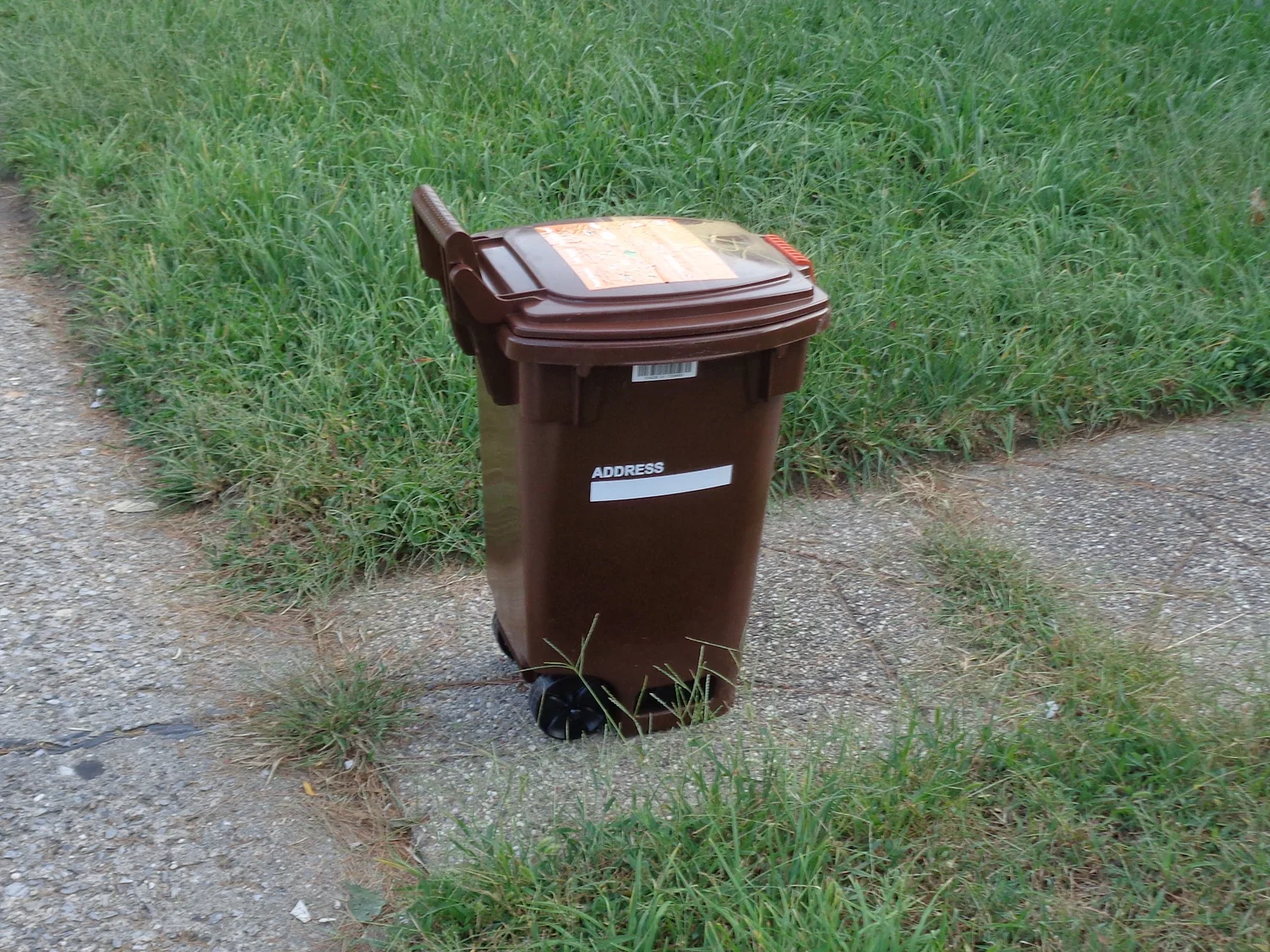
The old New York brown bin in the photograph is one recognizable part. It was distributed during an earlier period of the city’s organics collection work. Its presence in a photograph does not establish current rules for any address. The Department of Sanitation’s current service information is a better source for eligible materials, containers, when to put them out and any changes to the system. The useful thing the older image shows is why a separate container has to stand out as part of a different collection stream. Once it has a clear identity, the route can offer something quite precise to the people who use it.
The smallest container may do the first public job
A household can know perfectly well what the city collects and still have trouble managing a small routine in the kitchen. How far is the container from where the scraps arise? Does the person using it know whether this container is the one that goes to the shared bin? In a house with people moving in and out at different times, a short description beside the actual opening often does more useful work than a page of information somewhere else. Separation works best when a person can get it right at the moment it matters.
Take three imaginary things left after supper: a peel, its retail label and a disposable wrapper that accompanied another ingredient. They came out of one place at the same time. Their destinations under a particular program may differ. An item saying it is compostable under certain conditions is not necessarily accepted by the service a specific address uses. The facility and operator may have an intended set of inputs that limits what they can process together. Use the actual accepted-material list for the route rather than copying one from another city or treating a symbol found on a bag as confirmation.
A person moving from another building may bring a good routine that involved a different facility. The two buildings might both talk about food scraps, but the place to empty a small container and the way the public route collects them can vary. If residents have been consistently doing something the manager cannot accommodate, find out where they received the information. A simple conflict between two posted instructions can cause more mistakes than a lack of concern. Correcting the shared information gives many people a way to change the practice at the same time.
The building has its own handoff
Think of an apartment household that carries scraps downstairs every other day. At the first floor they see three closed containers against a wall. They are waiting for a visitor and do not have time to open every lid to see where the contents are supposed to go. A visible label on the actual container and a short sign at the point of decision can spare them an uncertain choice. Now think of a resident who can only reach one of the lids easily. The ability to identify the correct bin and the ability to use it should be reviewed together.
Somebody also has to ensure that the right building container is available and in a condition to use. After collection, it may need to be returned to its usual place. A transfer through a narrow door can be manageable when a bin is lightly loaded and difficult when it is full. Ask the people who actually move it rather than specifying the route in a memo alone. A successful handoff is not measured by how appealing the first poster looks. It gives material a workable next place to go.
From a resident’s point of view, a full bin and a missing bin are different conditions. In one case the designated place is recognizable and capacity has run out. In the other the route may have no obvious starting point until the bin is found. Record which condition happened and how long it persisted. If a building consistently fills its container well before collection, directing residents to read the lid again is unlikely to fix the capacity problem. If several nearly empty bins have conflicting labels, adding another one is unlikely to fix the information problem.
The truck sees another set of places
A collection route needs the material present at the correct location and time and in a form that can be managed. Someone observing an occasional missed collection can begin with fairly plain facts: which frontage, what was set out, when it appeared and which streams were collected. In New York the sanitation department’s curbside information gives the relevant service details. A description that identifies only the side entrance at which residents use a container might give the crew a different location from the frontage at which the container was put out.
It can help to put setout and collection on separate lines in a short record. The building may have set out the right bin after a truck had already passed. The arrival may have been delayed or changed and staff could have brought the bin back before it came. If the timing is unclear, write that down rather than assuming either the crew or the building did nothing. Proper reporting makes it possible to distinguish a missed collection from a missing handoff even when the unpleasant result at the entrance looks much the same.
A public drop-off program can provide another model. Boston’s Project Oscar describes a way to bring food waste to community drop-off locations under its stated arrangements. The participant brings the material to a public handoff instead of relying on the same pickup at home. Where that option exists, it needs reliable location information, instructions and access as well. A household with no usable bin downstairs may find a site easy to reach on an ordinary trip, or may have no convenient site nearby. Availability in principle and usable access for a particular household deserve separate answers.
One operational question concerns what happens after a long weekend or a service change. A notice can tell residents that the building’s shared container will remain in its usual place even when setout moves to another day. Elsewhere the main problem might be that a drop-off location does not open on a usual morning. Give these situations separate instructions. A person who carried material to the wrong location needs a way to learn the new handoff without being sent back through a general explanation of why separating it matters.
Look for small changes before proposing a large one
Suppose people in a building keep putting things in the wrong stream. Watch where they actually find out which opening belongs to which service. The label may be readable only when the lid is raised, or the two containers may have been shifted after cleaning so a wall sign refers to the wrong position. If a volunteer rearranges the signs every second week, there may be no need for a much longer education leaflet. Give the instruction a place that follows the bin and check the arrangement on an ordinary collection day.
A short report about a program should distinguish what is recorded at each stage. Participation can mean that households have access to a service, that they actually set material out, or that the material was collected without what the processor calls contamination. These are related measures. It can become misleading to treat an increase in one as proof of an identical change in the others. Before comparing buildings or routes, state what the measure counted and what it left unobserved.
A building can learn something without collecting detailed information about individual households. Record when a shared bin was available, whether a common questionable item kept appearing and whether a clear label resolved the confusion. If a collection concern needs an official report, use the current channel and attach the time and specific location. The best local observations are often ones that a staff member can check on another day. Keeping the report narrow makes it easier to find out whether the proposed change actually helped.
The person with the plate at the start has not been thinking about a truck. They are trying to decide where one thing goes. Someone else will eventually need to find a container at a known address and recognize its contents as part of an intended service. The distance between those tasks is covered by a series of arrangements, some written on a public webpage and some carried by a label that someone kept in the right place. When they work together, an ordinary answer at the sink can become useful material on a route across the city.