The Game Table That Stays in the Park
A public chess table comes with a board, a place to sit and a set of choices about who can join. Central Park’s Chess & Checkers House shows what the surrounding space adds.
In this story 5 sections
A chessboard set into a public table does half the work of setting up a game. Nobody needs to carry a board. The table is sturdy and already in a place where two people can face each other. Yet a first visit can stop before anybody makes a move. There has to be somewhere to sit, a way to reach the board and an understanding of whether two people may begin if a few regulars are waiting nearby. The game needs a board. The invitation to play needs more than one kind of support.
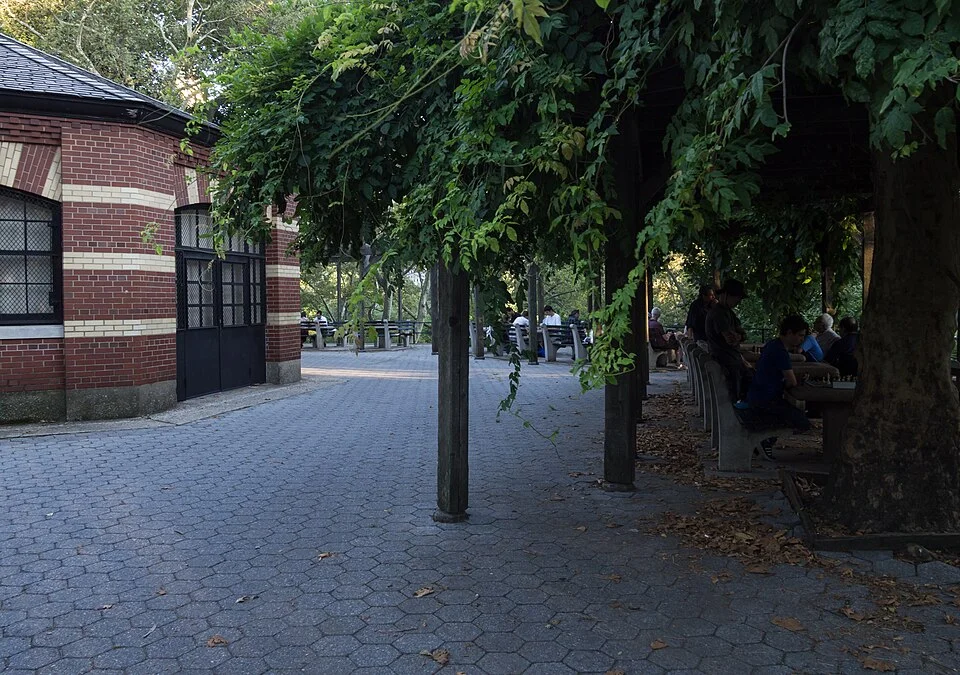
The Chess & Checkers House in New York's Central Park makes those expectations visible. The Central Park Conservancy describes tables around the small brick building and a trellis giving them shade. It describes a place to borrow pieces when the facility is staffed. Even on paper that is different from a row of seats dedicated to a single purpose. The visitor has a choice between bringing part of the game, asking for something and deciding when there is room to join.
A board is a surface and a signal
A square marked on a tabletop gives obvious information about what might happen there. A plain table can be recognised as a place to sit, eat or read without inviting a particular activity. The squares add a common starting point for people who have never met. One person can recognise the game being offered without interpreting a collection of signs. That is a useful feature for a place with many visitors and no need for all of them to take part in the same thing.
But a board does not by itself give the space a schedule. If a family is eating lunch at a table with a board on it, another visitor may not know whether the board takes priority. Where the rules do give particular uses priority, a notice should make them legible. Where uses are flexible, layout can do some of the work. Providing places to eat or rest nearby gives people an alternative to occupying the very few boards without asking staff or volunteers to arbitrate every overlap.
A painted or inlaid board also makes a long commitment to a place. A portable one can go indoors when it rains, then be brought near a crowd when a game is planned. The fixed board remains when play is not taking place. Its surroundings have to serve the next visitor as well as the last match. Water on the surface, deep shade or a source of strong glare will have different consequences at different times. Putting a board outside is the beginning of the design job.
The chair counts as part of the game
Both players need enough room to see and reach the board. If the only approach is from a side with a fixed seat, a person who cannot transfer to that seat may have no place to play. A useful table arrangement offers more than the possibility of standing beside a game. It considers support, turning room and the way an opponent sits at the same height. The placement of a table near benches or rails can affect those choices without changing the table's own dimensions.
The Conservancy describes adding flexible seating around the game tables as part of the restoration completed in 2023. Its restoration account also describes a ramp on the east slope, work to the stairs and public restrooms as part of the larger project. These are alterations to the approach and surrounding facilities as well as the immediate playing area. Calling the game accessible on the basis of the board alone would miss the distance a visitor has to travel to reach the chair in the first place.
A small thought experiment makes this clearer. Draw a table and place two seats at the shortest reachable edges. Then add a line for the approach to one end. Does a player have enough space to arrive and turn while someone else passes? Where can a spectator stand without pressing behind the players or blocking the route? A perfectly even arrangement among empty chairs can become difficult once people use it. Checking the path at the scale of bodies is as important as choosing the dimensions of the furniture.
Providing pieces changes who can join
A person who lives nearby can bring a set. A visitor who happened to pass the house might have no pieces. The availability of a loan turns the fixed board into something the second visitor can use. It also creates work beyond providing the table. Somebody has to keep pieces together, make them available under the published terms and receive them after a match. A choice about staffing can have as much effect on the opportunity to play as a decision about adding another board.
The Conservancy says games and tables are offered on a first come basis, and pieces can be borrowed when the facility is staffed. Check the operator's information for current hours, loan instructions and any return cutoff before setting out. Leaving a board accessible and making pieces available are two different services. If one ends at a particular time, a notice that refers generally to chess open can leave a reader unsure which condition has changed.
A short notice can guide two people with different starting points. One has a set and wants to find a table. The other is looking for the loan desk and wants to know how long the pieces may stay out. Put the rules that affect the decision together, using separate words for the boards, the building and the loan. If the word rental appears in one place and free to borrow in another, a visitor may go looking for a fee that does not apply. Precise names make an informal service feel more welcoming.
Give waiting a place of its own
A game can take a few minutes or much longer. First come access is easy to understand until nobody can tell who has arrived first or where they should wait. A group clustered behind one player's chair might be spectating or trying to hold the next turn. A layout with a little standing space or spare seating makes it more feasible to stay nearby without making the players feel hounded. A sign can explain any formal arrangement and need not invent a booking system where none exists.
Consider a parent and child who watch for a few minutes before deciding to play. Their reasons for waiting differ from a regular player's, but they still need somewhere to be. Too close to the table, they can crowd the match. Too far away, they may not see how turns are managed. A reasonably near place to pause serves both learning and waiting without making participation a condition of entering the area.
Shade and the length of a stay also go together. Two people passing through may scarcely notice the sun at one end of the table. During a game a player can spend the whole interval there. A trellis, trees or another structure can make that difference visible on a site plan, as can the time when its shadows actually reach the board. The older photo on this page shows the house and part of its setting in 2016. The restoration record gives separate evidence about later changes.
The room around the board matters
A park department testing whether a game table is working could watch more than the number of completed matches. Can visitors find a board on their first approach? Can two people move into position without climbing through another game's space? Do people arrive after the loan desk closes without realising it? Those observations distinguish a popular game from a site that works well for different kinds of visitors. A table with a queue is evidence of use. It can also be evidence of a need the space does not yet meet.
It helps to inspect the area during an ordinary hour as well as a scheduled event. During an event volunteers might explain rules or set out pieces. During a quiet period the signs and layout have to provide much more of the guidance. A permanent board should work for both visits. It does not need a formal introduction every time someone arrives. It needs enough room for two players, a way for others to wait, and a clear answer to how a match begins.
Maintenance is another ordinary test. Leaves can cover the grid without damaging the table. A loose chair can make one side unavailable long before an entire board needs replacing. On a cluster of tables, numbering them on a simple maintenance plan makes it easier to describe which one needs attention. A visitor's report can identify a location or a neighbouring landmark if no visible numbers are used. The board should be easy to find for somebody coming to make a repair as well as somebody coming to play.
The chessboard is the object everybody recognises. What turns it into part of a shared park is what has been arranged around it: the route and seating, the people who lend a set, and the conditions under which another pair can take a turn. You could remove every piece from the photograph and still see parts of that invitation. To know if it works now, follow the next visitor all the way to the table.