The Library Slot After Closing
A book drop lets people finish a return after the lending desk closes. The service only works if the slot, its limits and the confirmation of a return are easy to understand.
In this story 5 sections
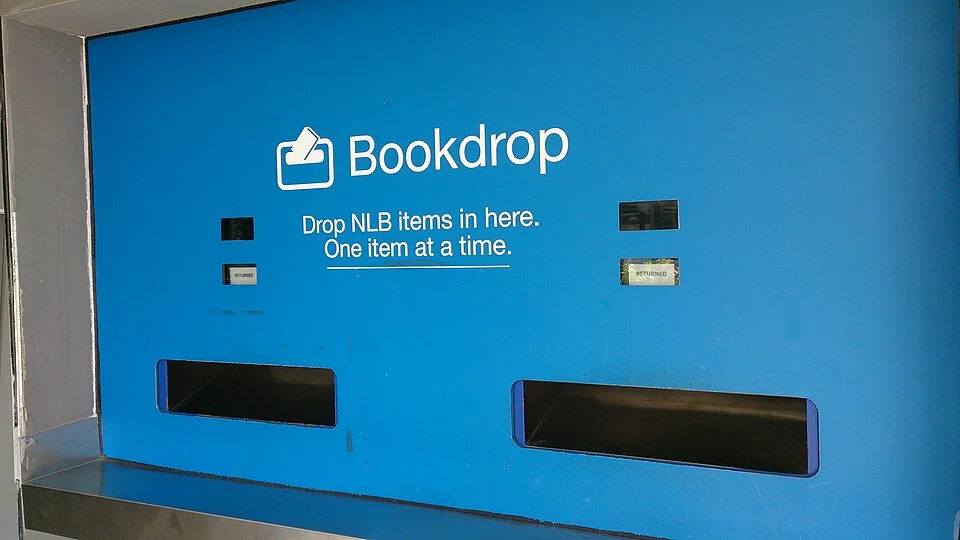
A bright blue panel fills most of ProjectManhattan’s photograph of a book return in Singapore. A short instruction asks users to put items in one at a time. Two long dark openings are easier to see than whatever equipment or storage is behind them. There is no member of staff at the front of the panel. The furniture does the first part of the work by making it possible to hand over a library item without an exchange at a counter. Some of the work that makes the return trustworthy cannot be seen in the photograph at all.
A public library has at least two doors in this sense. There is the front entrance, through which people can reach shelves, staff and places to sit. There may also be a small opening for items coming back, with different hours and a much narrower purpose. Singapore’s National Library Board explains the bookdrop in its visit guide for Bishan Library, including a photo of the facility and directions to its location on the first level. The photo above documents a Singapore library return but is not identified here as the one in that specific guide. Putting both kinds of evidence together raises a useful question for any library: how should a borrower know which part of the service is available after the rest of the building closes?
Being able to find the slot is a separate service
At the usual entrance, people know how to cross the threshold and ask a question. The nearest return could be here too, but its approach might change when the doors are locked. A slot in a wall to one side of the building needs a sign at the door people try first. A unit inside a concourse may have a clock of its own and a path that closes with the surrounding building. A map that describes the location during normal opening should be read carefully before assuming the same route works after closing. Instructions can help by including the approach and the hours together.
The temporary condition is important as well. Maintenance, a closed passage or a problem at a single slot can change what it is useful to do. A notice that only says unavailable does its first job. It stops a visitor trying again and again. It does another job if it directs that person to a suitable return during hours they can use. A web listing can provide the same information earlier in the trip. The people who are already beside the unit need it too, and they may have less time to look for it.
Think about the approach from the height of the person carrying the books. A large painted word above the slot is a cue at a distance. A reachable opening, clear space on the floor and enough light to read the instruction are useful for completing the action. Someone may arrive with an armful of items or stop with a bag on a wheeled frame. The route and the return surface need to leave enough room to use them. Being open later has less value if parts of the approach that make it possible to reach the slot are inaccessible later.
The opening can ask for a small sequence
The photographed instruction to put items in one at a time is a good example of how a bank of openings can say more than return here. Borrowers may find it easier to bring several books at once, yet the unit might need to receive them separately. Depending on the facility, a separate item can fit more easily, be identified by a reader or reach an interior container without another item obstructing it. The label in the photograph tells a person what to do. It does not prove which of several possible mechanisms is installed behind that particular panel.
A good instruction appears before someone has pushed the item past the visible edge. Perhaps only items borrowed within a network should go in. Perhaps some things, because of size or complexity, belong at a counter. A traveller with one standard book and a second object that will not fit needs to find out before trying to force the return. The scope of a useful sign is the current service. Requirements can differ among libraries and for different kinds of material. The broad expectation that an object is a library item is less precise than the return instructions the owner of the collection has set out.
A bank of slots can also raise the question of equivalence. Two openings at the same height and under the same label may be intended to share a service, or separate jobs may be marked on them. A clear sign makes the difference readable while it is still useful. With a group of people waiting, fine distinctions are easy to overlook if one is painted on a panel the previous visitor is concealing. Repetition close to the point of action can save the person at the front of the line from learning by a failed attempt.
An item disappearing is not quite the whole record
A borrower wants to know that the item is no longer on their account. A simple outside chute might receive it now for staff to process later. A system with automatic identification can instead take some of the recording steps while somebody uses it. The two services can look quite similar from a distance; both involve an opening and a book leaving the borrower's hands. When the account changes and what confirmation a person should expect are better questions than whether the box is inside or outside. The location does not establish the processing schedule.
A return may need evidence if something goes wrong. A message on a screen or another confirmation can help where a particular service offers one. A person should know what an unread item or a full container looks like from their side of the panel. The system can give a clear failure message or instructions for a staffed alternative. With a passive slot, the borrower might be able to check their account after the library's stated processing time. The important thing is to connect an action the person can observe to whatever record follows it. An unexplained interval puts an avoidable burden on the person who already left the building.
There is a useful separation between the moment the book was deposited, the moment it was checked in and the later moment it can be lent again. A shelf record telling someone a book is being processed may be right even after the borrower's account is updated. Equipment or staff may have to move it from the return area, sort it and examine it. An especially busy day can put those steps farther apart. Treating all three moments as one invites unnecessary confusion for the person waiting to borrow whatever was just taken inside.
Someone has to empty or sort what people leave
A return service can be unusually convenient from the outside and still take a careful routine inside. Staff have to be able to reach the collected books without leaving the public approach in the way. The capacity and condition of an internal container can affect whether the slot is available later. Where a library expects more returns at certain hours or following a break, a plan for clearing that load matters as much as the opening printed on the wall. The service is available to a visitor only while both sides of the panel can do their jobs.
It helps to imagine two small flows through the building. From outside, people arrive at different hours with material they no longer need. From inside, material has to reach the appropriate shelf, another branch or a place for attention. Not every object needs the same treatment. The return panel joins those flows while allowing them to run on different schedules. A clear record that an item has been checked in lets the second flow continue without asking the borrower to wait beside it.
Returning a book at another branch adds a possible stage to the inside route. A library network might offer that convenience for some materials while still having to transfer them to their designated homes. An update for the former borrower says little about how far that next trip has advanced. People awaiting a copy and people returning one need different information even when they are looking at the same item in the catalogue.
Follow the handoff
Look once more at the blue panel. The colour and large label make a return destination easy to identify. The narrow instruction tells a person how to put a book into the system. An access route and hours notice would tell them when that first movement is possible, and the library's processing explanation would tell them what to expect afterward. Together those pieces make the service more visible than the slot alone can do.
The great convenience of a book drop is the separation it creates. A resident can finish the physical part of a return as their own day allows. The library can receive and move the books through its own routine. A person deciding whether to use it should not need to see that routine behind the wall. They should be able to find the handoff and tell, with the help of a clear instruction, when their part in it is done.