Who Can Open the Village Noticeboard
A board can be open to everyone at eye level and still have a locked door. Its keeper has to decide what fits, how long it stays and what happens when information changes.
In this story 4 sections
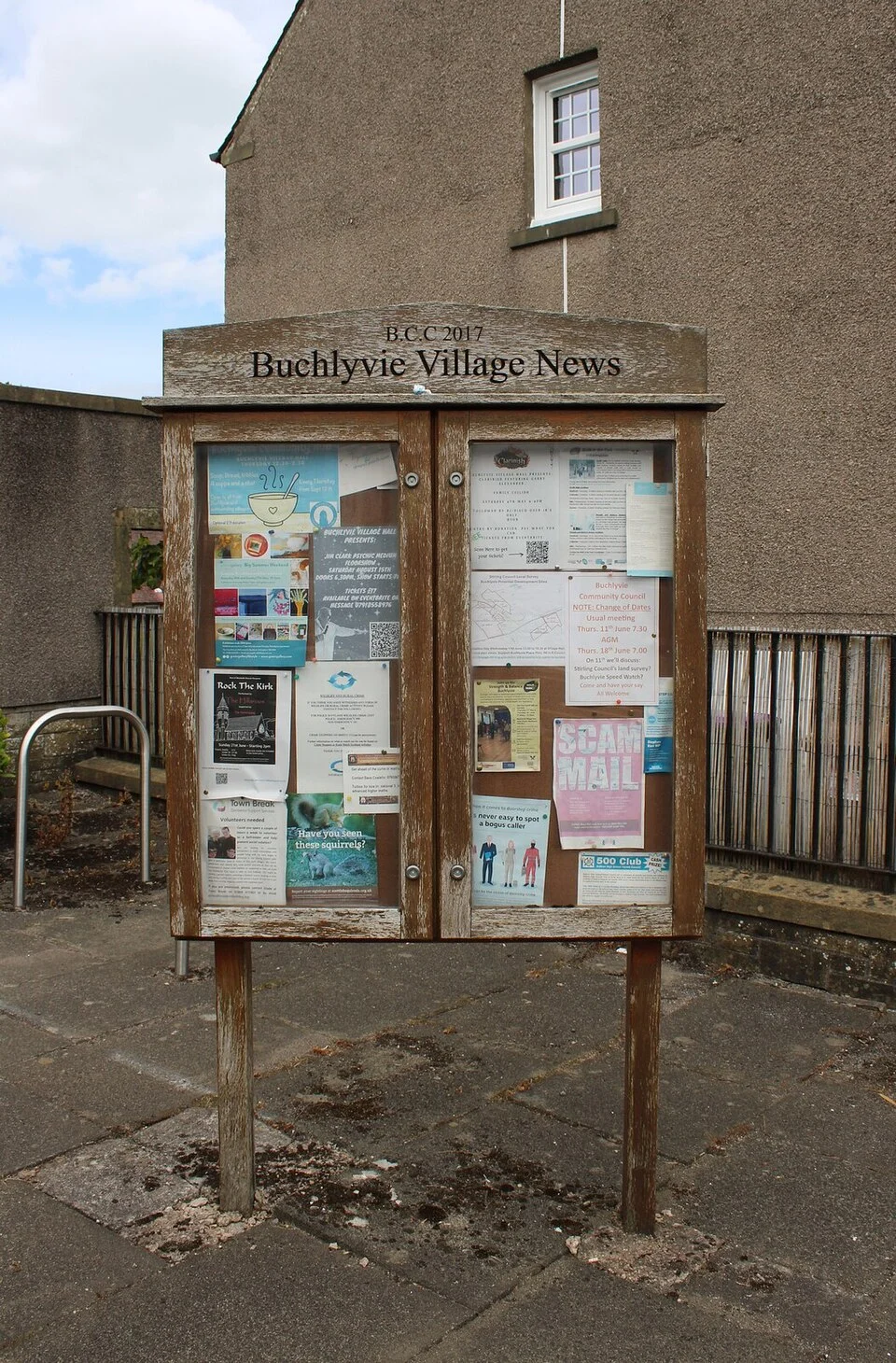
A glass door keeps the rain away from notices without keeping the notices away from a reader. The same door turns posting them into a different sort of action. Somebody has to open it, find a place behind the glass and decide what already needs to come down. In the photograph, many sizes of sheet share a board labelled Buchlyvie Village News. From a few steps away it looks like a collection of local information. Close up it is an edited space, even if nobody involved uses the word editing.
A public noticeboard offers one kind of access to the person reading and another to the person posting. The physical arrangement makes it possible to see why the two do not have to be identical. If every reader could squeeze a new sheet into the case, some material might be covered immediately. If nobody could find the person with the key, even a clean board could become impossible to use. Being public at the front does not settle how access to the inside is organised.
A key describes the way in, not the purpose of the board
Some boards are managed by councils, charities or other local groups. Their purposes and rules need not be the same. West Monkton Parish Council's published engagement policy is a specific example of how an operator can describe a group of noticeboards and explain responsibilities for them. It is not a policy for the Scottish board in the photograph. Stirling Council's Buchlyvie page is a separate example of local information available through other channels. Keeping the examples separate lets a reader see the common questions without assuming the same institution provides every answer.
There are several reasonable ways to give the right people a route to the key. A notice can name a place to submit items rather than expect someone to find a particular person. The board can be reserved for official or community use as stated by its owner. Another panel may allow a different range of announcements. The main point is that a person standing outside ought to be able to learn how to offer a sheet without knowing who maintains the hinges, or mistaking a visible display for an invitation to add anything to it.
It helps to identify affiliations on the sheets themselves. A community group can have an event at a place run by somebody else. A council notice can appear alongside an invitation organised independently. A title saying who issued it and a useful contact or official channel give the reader a clue about who can answer a question or correct a detail. Physical adjacency on a shared board is not evidence that two groups endorsed each other's notices.
A board with limited room has a schedule
Imagine a village hall meeting, a small exhibition and a club notice all needing space this week. A permanent community notice can still be useful next month. A poster for a festival ceases to inform readers as soon as the dates pass, unless it is saved as a historical record somewhere else. A tidy board on Monday may be full of yesterday's work by the following weekend. Devices for planning space, such as a designated size or a removal date placed on submissions, can help somebody decide what stays without having to remember when each page went up.
The point of removing old information is not just appearance. A reader can confidently copy the location of an event and still be wrong about when it happens if there is no year on the sheet. A recent notice can look older than an expired one printed on heavier paper. Give time at least two places: the date of the activity and, where useful, the point after which the notice should be removed. An operator can keep the display useful without discarding a record important to somebody else; that record need not occupy the public-facing space.
If a change is urgent, taking one sheet down is not the same as announcing the new condition. A meeting moved to another room may need an explicit correction that identifies the previous event and the altered details. The message should survive being read by a person who never saw the first notice. Where an organisation also publishes online, the display and page should give consistent current directions, or explain which can be updated faster.
The most readable sheet can still be in the wrong place
Glass can give strong reflections at one time of day. A board can be easy to use by somebody who has time to stand close and hard to read across a narrow or uneven approach. A bench, a ramp or a passing path can change who can stop in front of it. The starting question for placement is where someone expects to look for local information and whether they can pause there. Not every clear view in a photograph supplies that answer.
Scale matters inside the case as well. A date printed at the bottom of a dense flyer may become too small to read through glass even when the name of the event is obvious. A useful community notice puts the date, place and responsible group where a person can find them in a short visit. A flyer may offer a QR code for detail, but a person should be able to recover useful information without scanning one. Give an accessible contact or official route where possible rather than rely on a small link visible only to someone close by.
A keeper can test visibility from several points before changing the board itself. Compare a sheet pinned at the top and one at the bottom. See whether the backing or placement produces a reflection that obscures dates. Consider whether a wheelchair user can reach a position from which the information is visible without blocking a through path. The board's job is to make information public physically, not merely to hold paper behind a visible surface.
What the case cannot carry
One practical way to keep the spaces from competing is to choose the durable facts that need to appear on both. A village meeting notice can give date, clock time, place and organiser on glass and online. If the online copy contains a long agenda, the physical version can explain how to obtain it without reproducing every page. A person with no connection on the way past the board still learns enough to identify the event. The responsible group can be located by name later if more is needed.
Versioning can be done in very ordinary ways. Put the date of a changed notice where a reader will see it. If its location changed, name the previous venue and the replacement as part of the correction rather than leave the new sheet looking like a different event. Collect expired copies from any places that share the display. A reminder accompanying the new notice can indicate which date was superseded. These changes repay the attention of the person who supplies the key: little is achieved by unlocking a display if the new information looks identical to the old.
Consider a case where there is room for one sheet from each of several groups. If a notice is rejected because it is too large or does not give required details, a short explanation can make it possible to submit a better copy. Silence often looks like a broad rejection when the actual issue is a format or date. Conversely an agreement to post should be distinguishable from endorsement of the contents. A consistently applied display rule lets a local operator make the space available without taking on responsibility for every group's scheduling and announcements.
The Stirling Council page provides local information through a separate channel from the noticeboard shown here. Comparing an agency page and a photograph of a board is not a way to determine who put each item behind the glass. It is a way to see that different channels remain useful. The online account can provide longer records and be consulted outside the village. A physical board meets someone already passing one place and gives them a chance to notice information they did not think to search for.
A public board has a natural advantage at a place without a shared screen. Someone looking at it does not necessarily have to sign in or know that an organisation has made a digital announcement. Equally, the board cannot update itself when an organiser moves a meeting. A useful role for it is to carry durable, essential facts and a dependable pointer to current information. A website can be checked at another time, while an address and date on paper may be enough for somebody making an ordinary local plan.
The display need not solve every part of public communication. Its keeper should be findable, its notices should explain why they are present and its location should give more than one sort of reader room to look. The small glass door makes each of those choices visible. Locking it protects a set of announcements. What gives that protection public value is knowing how information gets in, how it is read and how it is put right when the sheet behind the door no longer describes something that will happen.