What a Blue Plaque Can Fit
A London plaque connects a person to a particular wall by choosing a few words. Researching that relationship is a different public job from celebrating a whole life.
In this story 5 sections
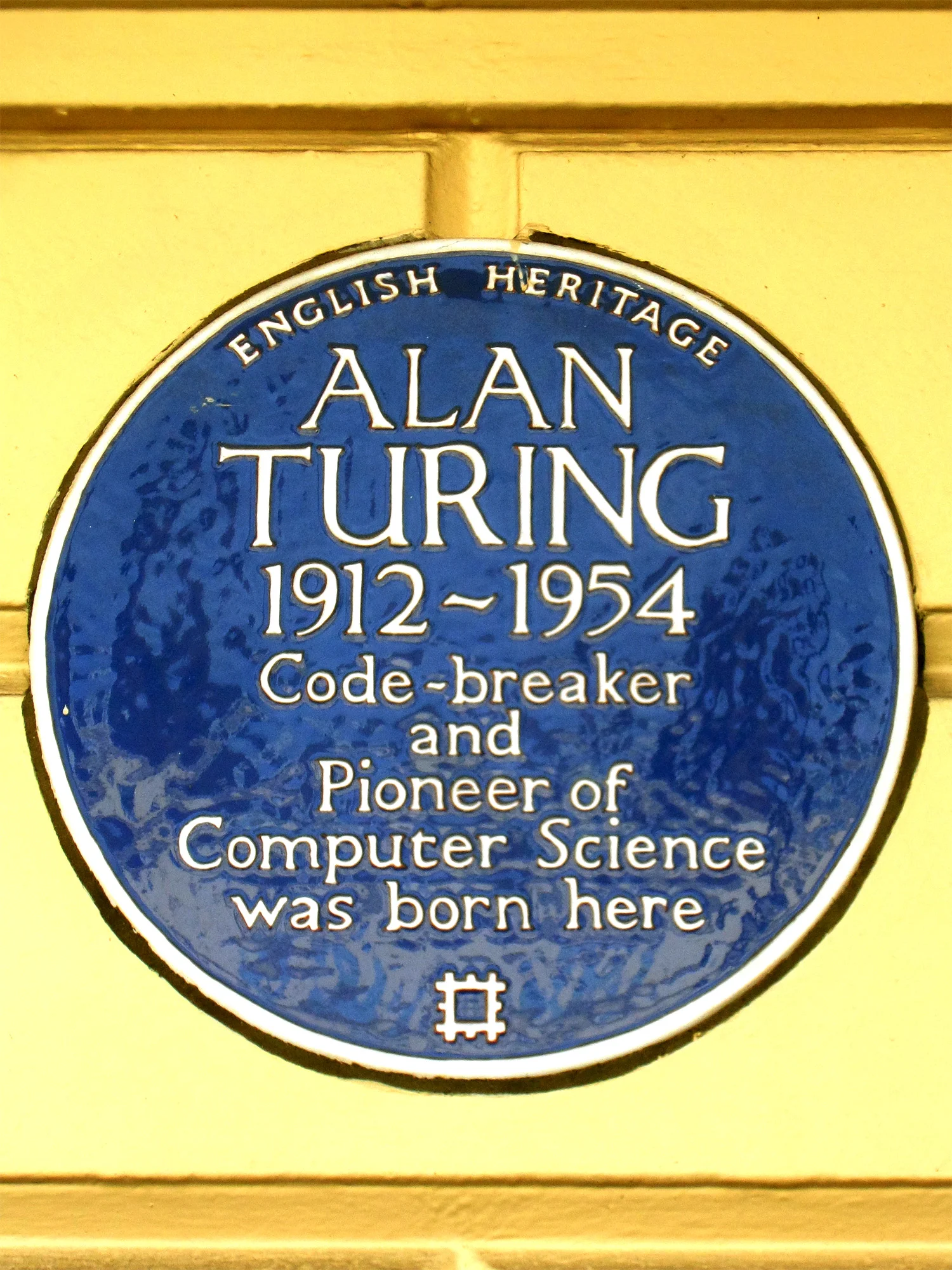
A small blue circle on a London building offers a surprisingly specific kind of statement. It is made to be read from somewhere ordinary, possibly in the course of passing an address you would otherwise have little reason to remember. At the birthplace of Alan Turing, the label joins a name known for other places and work to a particular fact about the building in front of you. A reader is not being told that everything for which Turing is remembered happened inside. The plaque singles out one relationship and gives it a few words rather than trying to accommodate the larger life the name brings into the street.
English Heritage explains its London plaque scheme and the process by which people can propose subjects. Whether a proposal succeeds depends on more than the attractiveness of a biography. There is the connection between a person and a place, a question about how it can be documented, and what the scheme can commemorate in the form it uses. Other plaque schemes can have different rules. The interesting public design is what becomes possible once people distinguish an important story, a suitable site and the particular assertion the finished plaque will make to a stranger.
The place has to carry the verb
Read an inscription for its verb. “Was born here” is quite a different relation from “worked here,” and neither says precisely what “lived here” would say. In conversation, all three might enter under the name of an important place in a life. The short statement on a wall needs to decide which one it can actually make. English Heritage’s account associates Turing’s birth with the then nursing home at Warrington Lodge, 2 Warrington Crescent. The photograph makes that physical reference visible. Other documented places relevant to Turing’s work are useful in a biography and do not give this one its own reason to be identified.
A street number can change or come to identify a different part of a building. A careful record should be able to connect an old description to a present physical site with trustworthy intermediate evidence, such as dated addresses, maps or records from the institution involved. The task is especially clear when several related households used the same surname or when an adjoining house has a similar entrance. Place details deserve the same care as a date in a biography. It is hard to have a convincing public marker if the distinguishing fact is something everyone was supposed to assume.
A good account can keep one fact open while establishing another. It might prove that someone lived on a particular street but indicate that the exact house needs more work. It could establish an event at an address and leave uncertain which doorway service visitors used. The public inscription should fit the strength and purpose of that evidence. Choose words for what can be responsibly connected to the wall. A small mark with a clearly supported verb can serve more readers than a whole paragraph of strong claims in a less convincing place.
A short inscription still needs a long decision
A historical statement, a scheme’s selection process and the physical design of its plaque are separate undertakings. A candidate can have a well documented connection to a building and still be considered under criteria about the subjects and kinds of commemoration a scheme offers. A first proposal may lead to further research or to the choice of a different wording. None of these facts can be established by finding a particularly strong paragraph about the person in an old book. Public guidance helps proposers give the group conducting a review the information it actually needs.
Think of making a modest working file for a hypothetical proposal. Put the intended relationship to the place at the top. Under it, record what evidence supports the identification and which important facts come from elsewhere. Add a line for what remains uncertain. A couple of sources that independently support the place and date can be more useful than a collection celebrating how remarkable the person was without identifying where an event took place. If later research changes the location, your file should make it easy to see what other claims remain valid.
There are also practical questions at the building. A phrase that uses “here” depends on the relationship between sign and site, and the ability of a reader to see it from ordinary public space. The appropriate authority may need to consider permission, the treatment of a building and how an installation will fit the existing fabric. Conditions vary by scheme and property. A proposal file and a completed plate have different jobs. Keeping them distinct gives the people reviewing it room to examine these parts without treating a preliminary suggestion as a public commitment.
A shape tells readers where to look
A plaque can have a distinctive color and still be hard to read. It might sit unusually high, have a fence in front of it, or be in a place where the view from the usual direction lies at a sharp angle. Rehearse the act of walking past on a small sketch of the street rather than only on a close photo. At what point does the circle come into view? Can a reader stop safely and have a clear look? Even a short phrase means little as public information if it can be made out only by standing in an unlikely place where people cannot go.
Use the shape to distinguish a symbol from the text it carries. From farther down the street you may recognize a type of marker before you know who is named. That recognition is useful: it tells you an ordinary part of the wall has something to disclose. Closer up a date or verb starts to do the real work. A good online entry provides an additional form, with the text and historical account readable by someone who is not in the street. The close photograph of the plate is one part of that information. An address and a name can travel separately and should be kept connected.
A photograph can also isolate the inscription so completely that the site disappears. If your question is how the device serves the street, keep a wider view or a documented map reference. If it is whether you transcribed a name correctly, a close and straight image may be exactly the right thing. The two representations can work together. Where a rendering makes the plate appear very large, a reader should not be led to expect a comparably conspicuous thing at the corner of an ordinary building.
Read a plaque as part of a set
One viewer walks past a single commemorative plaque. Another uses the scheme’s directory to see which kinds of links and people have been recorded along several streets. This second use is quite different. It can show concentrations, gaps and changes in what earlier selection groups chose to recognize. The plaques are not a tidy census of noteworthy lives. They represent a series of nominations, research and decisions tied to particular rules and buildings. A gap may give a reader a worthwhile research question without proving nobody made a contribution in the relevant place or field.
A directory record can show a date of installation independent of the dates inscribed on the face. Those are different histories. The years engraved next to a name can mark the life being described; the year of placing a plate can offer evidence of when the public decision was made. Things in a photograph such as the tone of the wall can be interesting context, but comparing official installation dates will tell you much more about which commemorations were made together.
One might give the proposed connection to a place and the reasons for selection separate paragraphs in a longer record. A short plate cannot tell everyone what evidence was checked and how the choice was made. Keeping that supporting history available gives a reader a meaningful way to ask about the next case, instead of trying to infer the entire process from the colors and phrases on the plate.
Give the omitted history somewhere to go
A plaque that reports a birth does not have room to describe all later work, relationships or decisions. That limitation can help someone write an accessible description if it gives the larger story another place to live. A scheme page can set one address in a broader account and give readers ways to continue. Conversely a street marker can still do a striking amount with just a date, name and verb. It allows a distant story to attach to a modest physical location without requiring the location to explain the whole life.
Return to the word “here” in the photograph. On the page it can be easy to read past it and bring your own favorite story about the person along. On the building the word makes a much smaller and more checkable assertion. The result depends on research, selection, permission and a legible design. Those things allow the plaque to meet the reader for a few seconds. If they want the rest of the story, they now know which door it began beside.