What a Repair Café Sends Home
A neighborhood repair event can send someone home with a working item, a next step or a better explanation. Organizing for all three makes the short visit more useful.
In this story 5 sections
At one end of the room someone has taken the feet off a chair. Nearby a person is discovering why a coat turns out to have two seams where they expected one. A visitor with a different object is waiting to learn whether anybody there can look at it. These are three quite different stages of a neighborhood repair day. A team that counts the finished repairs has a reason to remember the first two. The person waiting at the entrance has an equally good reason to care about what happens when an item is too awkward, unsafe or simply unfamiliar for the next table.
Repair Café International describes occasions on which people can bring broken objects and work with volunteers who have tools and experience. A local gathering has its own scope and arrangements. In a useful public description, say what can be looked at, how the waiting works and what kinds of results are possible. A community repair event has much in common with a room set up for people to learn. There is a practical decision to be made about what everyone can do in the time and space available, and what evidence the visitor should leave with even if the object still needs work.
Take the item to a person, not a general promise
Imagine a visitor carrying in a coat with an open seam. A sign saying “clothes” could be enough to get them into the right part of the room. Suppose they also have a small appliance with a problem they cannot describe. The same sign gives no help with that item and should not have to. A first conversation can establish the kind of object, the observed symptom and whether someone at the event is prepared to help under the local rules. It can also distinguish a request for help learning from a request for an immediate completed repair.
A sensible intake takes a small amount of information. What stopped working, when did the person notice it and where in the object does it appear to happen? If a dangerous condition or materials outside the event’s scope are involved, refer the visitor to appropriate qualified help without attempting the work. An unambiguous way to decline an item can be an important service to the visitor and the rest of the room. No one has to open something merely in order to give a well-founded explanation of why its next step belongs elsewhere.
The part of that process that people tend to omit is the way back to a table. If a familiar volunteer is busy, can the visitor hold a place while somebody identifies where the item belongs? If someone is already working at one station, can another person describe what is waiting without exposing unnecessary personal information? A small sequence of numbered places or clearly named tables does much of this work. The person carrying something fragile should not have to circle the room twice in order to find where a decision was made.
Think about more than one useful result
One object might be made usable during the event. The owner can then know what was changed and which conditions, if any, remain to be checked. On another table someone might establish that an appropriate part is missing and that little good can be done until the part is supplied. In a different case visitors may learn to describe the fault accurately enough to seek further help. These are not three levels of pretending a repair occurred. They are different outcomes that can be communicated clearly.
Try a closing card with room for what was observed, what was done and what remains. Give it to a visitor who has spent half an hour concentrating on the work and may not retain every explanation. If another visit makes sense, note any information that will help the next person recognize the object and the earlier decision. There is no need to keep names or other personal details for a tally of outcomes. A practical follow-up should leave the person who brought the item with adequate information rather than leaving an obscure entry that can only be interpreted by the volunteer who wrote it.
A return can become hard to organize when the event takes place only occasionally. Say whether the next gathering and the hoped-for volunteer are actually known. A contact for finding current hours or offers is more useful than a promise that the same help will be there two months later. Even a successful first inspection has another side: the visitor carries the item home and needs to know what condition it is in. Clear language on the card does more useful work than a checkbox saying simply finished when there are important limitations to the result.
Give people room to watch what is going on
A space devoted to sharing repair skills has different requirements from a collection point. A visitor can benefit from seeing a seam or watching someone identify where a worn part belonged. That is easier to arrange when there is room for a chair or an unobstructed view without interfering with other tables. An apparently generous room can fill up quickly where people gather at the same moment. Map the route from intake to one busy table, a quiet place to wait and access back to the door. The event should have somewhere for a conversation, not merely places to receive a box.
Learning together also occupies time. A queue in which a worker can take questions while waiting for a part looks different from one in which everyone needs the same people and tools at one moment. The group can identify which activities regularly require a long slot and give a clear account of what will happen for visitors who arrive when it is full. Any limits and waiting arrangements should be understood from the current organizers rather than copied from another group’s signs. A reasonable arrangement is one people can learn about before standing beside the crowded place it was designed to protect.
At the end of the day there may be a tempting count of how many people came. That figure belongs in a record if it helps the team. Ask also how many items were repaired, how many went home with a meaningful next step and where a limit prevented work. It is not always useful to make those shares match one sort of story. A good event can help somebody know whether a particular repair is within reach, even if a first visit did not have the part or expertise it would require.
The volunteers need a map of what is ready
Start with the room before people arrive. Mark which activities have reliable volunteers, the supplies each can use and whether a station has space for one visitor at a time. Write a description someone looking at a sign can understand without recognizing the names of the tools. Where a skill is unavailable, make that visible early rather than encouraging someone to wait for a person who is not coming. The decision can protect both the visitor’s afternoon and the volunteer’s ability to concentrate on the things they can usefully do.
Repair Café International’s general house rules illustrate how even the next item can have a place in such a plan. In its example a visitor who brings a second object may have to join the queue again. The practice keeps a first useful turn visible for other people without requiring everyone to arrive with exactly one thing. Follow the actual host’s arrangement. The broader point is that a queue is a way of distributing someone's time. If it has a consequential rule, make it readable before a visitor and a volunteer are already deep into the work.
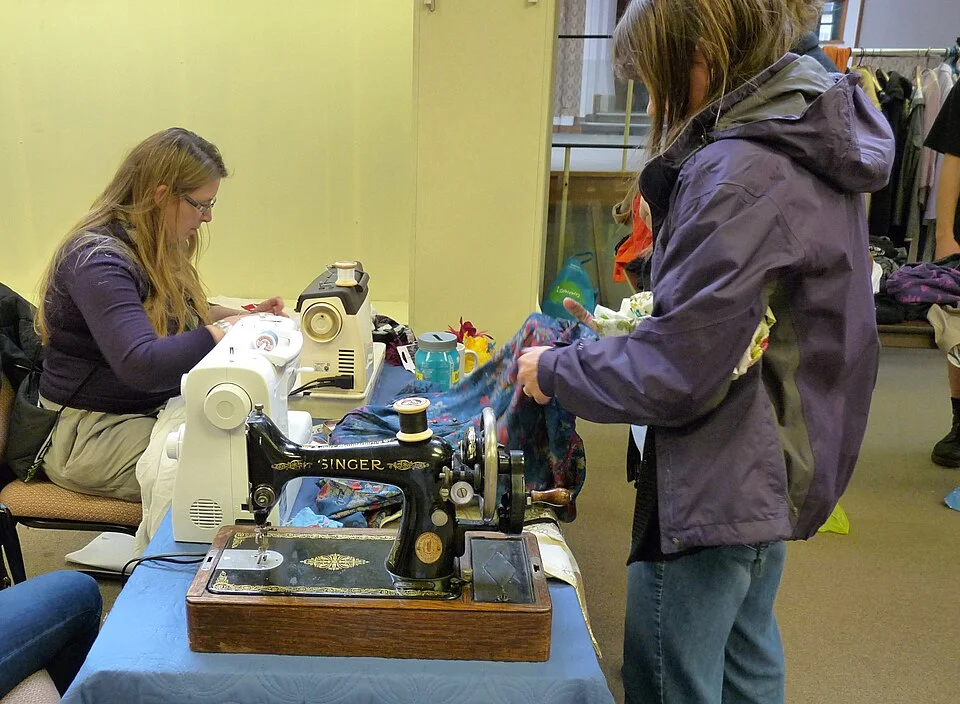
Take a sewing station as an uncomplicated example. Some visitors need to see what an ordinary mend looks like on a scrap before their item is handled. Others arrive needing to know whether the fabric can support the work at all. A volunteer can have good reasons to spend several minutes on either conversation. The group can plan for such demonstrations and triage, rather than allocating the same tiny block to every arrival. Observe where learning actually took place when reviewing what could be offered at another event.
Finally leave the next host a short record of the arrangement. Which stations filled first? When was a different waiting place needed? Which referral information turned out to be unclear? Aggregate observations about the event do not need a collection of visitor names. They give next month’s volunteers information of the kind this month’s visitors needed.
The last thing to send out is information
The person with the coat can leave in something better than they brought. The person with a more difficult object can leave with a reliable description rather than a guarantee. The difference should not depend on their luck in overhearing an explanation while a table packed up. A brief record makes it possible for someone to return later or describe what happened when they seek help elsewhere. Looking at the room as a place that lends knowledge as well as tools gives more of those outcomes a way to leave through the same door as the people who needed them.