What Makes a Curbside Parklet Feel Public
A parklet in a former parking space can give people a place to pause. Signs, entrances, seating and the path past it determine how easily a stranger can tell who is welcome.
In this story 5 sections
People walking along a busy street can pass a row of seats and wonder whether they belong to the business behind them. The seats may sit on a platform extending from the curb into the space otherwise occupied by a parked car. That makes the layout unusual enough to attract notice and familiar enough to be mistaken for outdoor service. Whether somebody decides to stop can depend on a sign or a small clue about where to enter. The opening between the sidewalk and the seat is part of what the parklet offers.
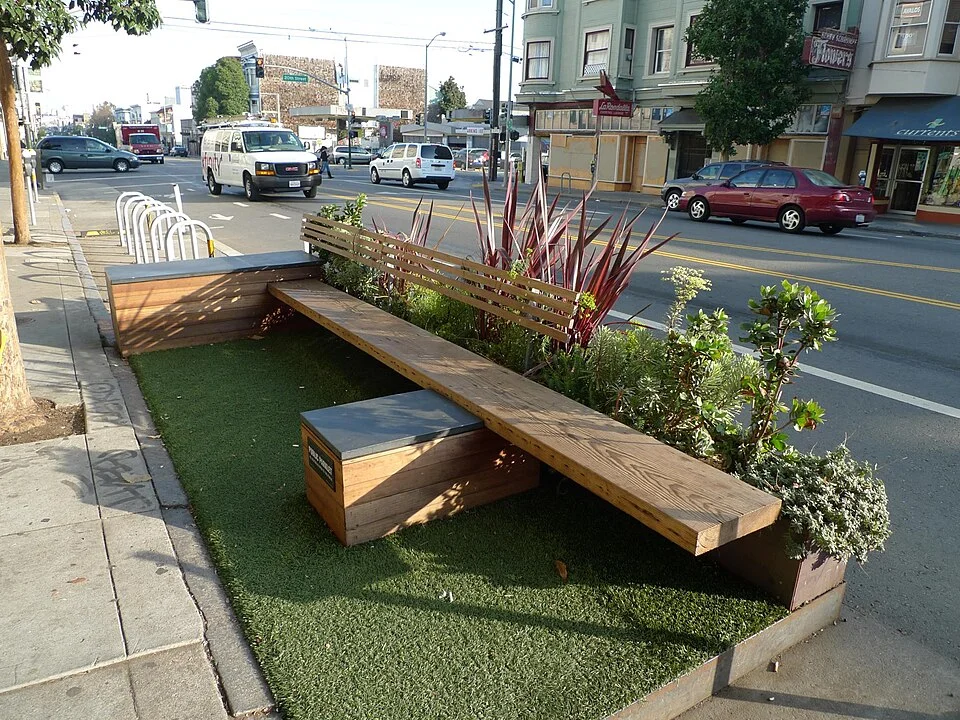
San Francisco has published information about parklets and shared spaces since before many cities adopted similar arrangements. Current city materials describe several kinds of permitted use and include ways to identify them to people on the street. The cover photograph shows Freewheel Parklet on Valencia Street at the time it was photographed. Its appearance is useful to an observer trying to see the relation between path, curb and deck. The current status, hours or use of any particular structure depend on its posted information and the applicable rules. The color of the platform alone cannot supply those details.
Approach as someone without a reason to be there
A person heading to meet a friend is a good model for a first visitor. They have no order to collect and no invitation to enter a shop. Stand where that person would come down the sidewalk. Can they see an obvious way onto the platform? Is there a sign describing when and how it can be used? Can they tell the difference between seats open to the public and a nearby business area with its own conditions? These decisions can be made rapidly. If an answer first requires approaching a server or stepping past a barrier that appears private, people who might like to stop can simply keep walking.
Where a sign is provided, test its placement as well as its words. A notice visible from inside the platform may be of little help to someone deciding whether to enter. If a sign identifies shared seating and gives hours, make sure the reader can connect it with the right space. There might be a cafe table on one side and a seat for general use on the other. A generic sign in the wrong position can leave both apparently claimed by the same business. The city's signage material illustrates how a system can try to make different permissions legible, and the street still has to make those instructions usable in a very particular place.
A visitor should be able to decide without knowing the history of the program. The clues that remain when they miss a sign are therefore helpful to examine. Do paths inside run directly to a set of public-facing seats? Does the opening appear to serve a line waiting for a counter? Can a passerby stand at the edge for a moment without obstructing another entrance? The questions concern actual behavior and ordinary appearances. They can be observed without assuming that every unoccupied chair would have been used if a message had been different.
Keep the movement past the parklet visible
A new place to sit changes the curb, but it also changes which parts of the sidewalk can carry movement. Draw two lines on a plan. One follows the through route used by somebody continuing along the street. The other moves from the sidewalk toward the seats. If the second line crosses a place where several people typically stand, the difference can be much more noticeable at a busy time than it was on the plan. A seat facing the street can support watching and conversation. Its usefulness still depends on what happens around the approach and around the people already using it.
Look at where the deck meets the sidewalk and how a person can continue inside it. Any change in height or route that appears very small in a photograph can matter to somebody trying to move across it. The space at the approach may also have to support a turn and provide passage while others walk past. San Francisco's program includes its own design and access requirements; check the appropriate official guidance when considering changes. For a routine observation, a good note describes the entrance and the available path at the time it was used. It does not need to decide from a distance whether a particular structure meets a specific standard.
Also pay attention to the boundary toward moving traffic. The seats can be designed to take advantage of a new place at the curb, and it remains a location beside a street. From within the platform, see what direction the seat faces, where its users could reach the sidewalk and where they could be close to vehicles or cyclists. From outside it, see whether the platform changes what people can see around it. A useful report gives enough context to understand which movements intersect. A photograph of an attractive bench is only part of that view.
Watch an ordinary change of use
At one hour, people might use the place to wait for somebody. At another, a few friends might eat lunches they bought separately. Workers might need to clean the deck or remove an obstacle. Notice how long the same portion of space is available for anyone else during those situations. The point of observing use is to understand the range of activity the design supports. A successful photograph of a full parklet does not establish that a newcomer can find a seat or that its approach stays clear. A photograph taken while the deck is empty supplies even less evidence about the busiest moments.
A different day can reveal another issue. Sun or shade moves, and a path that works well with two people waiting outside a shop can work differently when many more arrive. The edges of a small deck make those changes easy to miss. Check the places where the route first narrows and where a person can step aside without getting in the way. If you notice a recurring problem, name the hour and the particular location. A description of the entrance at a specific moment is easier for somebody else to act on than a general verdict about a whole street.
Describe the place the way a neighbor would find it
A good short description includes the location, the access information shown on site and the route that connects the platform with public sidewalk. It might mention that a seat faces away from a particular entrance or that a person can see the sign before joining a crowd. Distinguish a dated observation from up-to-date information supplied by the operator or city. The older image accompanying this article gives an example of one street arrangement. A fresh visit or a current listing would be needed to describe how the same address is used today.
Then imagine trying to help a visitor find a place to rest quickly. Tell them which approach is clear, what signage to look for and what the setting offers once they reach it. If the place does not give you that evidence readily, you have found something to improve. Adding seats to a curbside space is a visible achievement. Making it possible for someone who has never seen the structure to recognize the invitation and find a sensible way to accept it is what gives the small space an everyday public use.
Compare the public invitation under different conditions
What would you expect to find when the adjacent shop is closed? If the parklet has independent hours, the answer should come from its own posted information and current local conditions. A bench behind stacked furniture can lead people to a different conclusion from the words on a notice. Conversely, a quiet room beside the platform does not necessarily mean that the platform itself is closed. Checking the approach at two ordinary times helps reveal whether the arrangement communicates the same rules when some of its usual visual cues are gone.
Now think about somebody who can see the seats and still cannot see how to reach them. The obstacle could be a change of level, a path too narrow to turn at or a line of people with an entirely separate reason to be there. Describe the route from a specific point on the sidewalk. Avoid assuming that a person who comes from the opposite direction will meet the same obstacle at the same place. The most useful proposed adjustment can be small, such as changing where an information sign stands or keeping an identified stretch of approach clear. Its importance comes from the part of the trip it makes possible.
If you compare two parklets, keep the comparison tied to a shared task, such as finding a place to rest for a few minutes. Look at when each gives somebody enough information to begin the task and what that person has to do next. The spaces may offer different types of seating and different relations to nearby activity. Both can be worthwhile. The comparison shows which part of each invitation is easy to accept and which might take work from the person who has already chosen to stop.
If the city or operator supplies a contact for the space, make that contact easy to associate with the correct deck. A precise public observation is more likely to lead to a useful correction when it reaches the person responsible for the place where it occurred.