What the Plate on a Postbox Tells You
You can drop an envelope into a street box while nobody is there. The small plate beside the slot explains how that unattended action becomes a scheduled collection.
In this story 5 sections
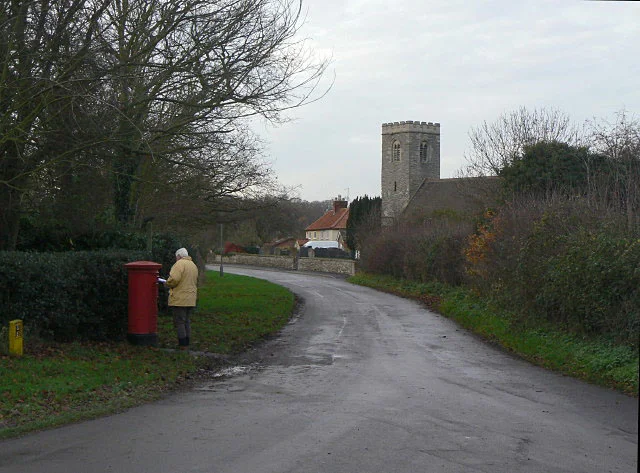
A person is standing beside a red pillar box in Alan Murray-Rust’s photograph of Syerston, England. Beyond the box the lane bends past bare trees toward a tower. The conspicuous colour tells a passerby which object has to do with mail. The photograph was taken from too far away to read the useful small print on it. To a person holding a letter, that print can matter at least as much as the colour. It is the point where a fixed object reachable from the street tells someone about work that will happen at a later hour.
There are three times involved in posting. One is when the letter enters the box. Another is when a worker empties it. The third is when it is carried farther in the delivery system. The slot makes the first of those things possible without coordinating an appointment. A collection notice can help the sender reason about the second. Neither promises on its own what will happen by a certain hour at the letter's destination. This seems a small distinction until someone is standing beside a box trying to decide which of two possible places to use.
Two journeys meet at one fixed point
A street box has to make sense to the person arriving on a daily walk and to a worker picking up mail on a route. The pedestrian may place it using a landmark, perhaps the beginning of a lane or the wall of a familiar building. A collection record needs a way to refer to that object even if landmarks change or there are two boxes close together. A location can be both easy for a resident to describe and one of several similar stops for the operator. The name or reference on an information plate gives those two audiences something they can identify in common.
Think about the situation of someone new to a village. A red object at the turn in the lane is a straightforward visual cue. A map would still help them discover it before they walk there. Include which side of the road it is on or a useful nearby junction, and the answer can work even if the person comes from the other direction. The label should be enough to confirm that the box a person sees is the one they looked up. A schedule for a different box with a similar name could be accurate and still lead them to a poor decision at that point.
The worker reaches the same box with a different need. There must be a way to approach it safely and to get to the part that can be opened for collection. A spot easy to see from a wide intersection might be harder to reach with equipment than a slightly less obvious position. Changing the location affects more than the map pin. It changes where those two journeys join. That is why a replacement site needs to be considered from the road, the pavement and the routine of collecting as well as from the point of view of a photograph.
Read the hour as a collection hour
Royal Mail has a location finder and publishes listings for individual boxes. One example for a box at Medway Mail Centre distinguishes a last collection from other descriptive information. The details for that site are not details for the red box pictured at Syerston. Read the information attached to the particular box a person is deciding to use. A printed time on a plate or an hour shown in a listing needs a day, a meaning and the right location. Those conditions turn a number into something the sender can act on.
An imagined plate says the final scheduled collection on a given day is at four in the afternoon. Someone who puts in a letter at half past three has a different basis for expectation from someone who arrives at five. The slot can still look and feel exactly the same, and there might be no staff visible during either visit. The schedule concerns when mail is planned to be taken out, rather than when the box can physically take an envelope. If the deadline matters, the next listed collection and other verified posting options do more to inform the choice than knowing that the first slot is open.
Consider also someone looking at the plate just before the listed hour and hoping to see whether the visit has already taken place. A regular time is a plan. A separate status indicator, if one is provided for the particular box, is a different kind of information. A sender should not infer an extra trip on a certain day from a plate that states only the last planned collection, or assume there has already been a collection just because another box on another street has been served. That distinction helps explain why a familiar route is useful for everyday expectations and not a precise live tracker for a particular envelope.
The small plate is part of the public face
A person probably spends only a few seconds with a collection notice. Its most useful text is often the part somebody needs to read while holding other things. Think about a sign installed below the slot, whose angle makes a dark surface reflect the sky. It could be legible in an office and difficult on the street at noon. A block of large print that identifies a landmark is valuable, but it cannot do the work of a clear schedule. The typography serves different moments of the same encounter: identify the fixture from a distance, then read the details close to it.
The physical conditions around the box deserve the same attention. A slot can be reachable by one visitor and awkward for another when the approach is bordered by a high kerb, soft ground or parked vehicles. Readability can go wrong before anybody encounters the plate. There has to be a suitable place to stop and look. Where a box sits against a wall, the absence of space behind it may matter little to a customer and quite a bit to the people deciding which type of box can be serviced there. A pillar box and one mounted on a support can offer similar posting functions while meeting the space differently.
An online listing can provide an alternative way to see information in larger text. It is still useful to have consistent signs at the actual location. If the hours on the listing and fixture appear to disagree, somebody trying to meet a deadline has a new uncertainty to resolve. A well-managed change therefore concerns both displays. Signage tells a person already on the pavement what to do. The listing guides a person who can still decide where to go.
Then the letter enters a bigger system
The Postal Museum's educational material follows a letter beyond the point of posting and into sorting. Collection groups together letters whose senders may have visited the same place at very different times. The bundling is one reason a street box is useful. The worker does not need to meet every sender and the sender does not need to find the worker. The collected mail can now join mail brought in by other routes. The location of the red box matters less to the later path than it did to the first handoff.
It also follows that the collection hour does not tell a reader everything about arrival. The item still needs the service and address intended for it, and next comes processing with other mail. Some enquiries are better answered by finding current guidance for the service or the type of item than by looking at the plate. The plate has a narrow and useful role. It says something about the transfer from this public location to that larger process. There is little reason to expect a small piece of metal on the street to describe all later stages.
Every so often a change may alter that first transfer. Consider a fictional case in which road work prevents normal access to a box for several days. A note giving the name or location of a nearby alternative does more than saying it is out of service. If the changed arrangements have an effective date and have been reflected online, a person can see which plan applies before reaching the lane. Temporary information has to be easy to remove or replace once normal use resumes, or it becomes another piece of outdated guidance.
Leave enough information for the next person
Next time you see a street box, consider how far from it you can make three decisions. You may be able to recognize it from across the road. It may take a closer approach to identify its exact location or number. Reading the next relevant day and time might require a clear place to stand and a few seconds of attention. The needs of a person who uses it every week and someone trying it for the first time are not so far apart. They need enough information to connect the thing they see to the service they intend to use.
The person in the Syerston photograph and the worker who comes later never have to meet. A narrow slot, a place beside the lane and an agreed collection are enough to put them in sequence. The photograph shows clearly where the first encounter can happen. The small plate belongs in the account because it makes that later encounter part of the first visitor's decision.