Where the Storm Drain Sign Points
The message painted beside a storm drain is a small public map. It shows why a seemingly harmless decision at the curb may matter far beyond that block.
In this story 5 sections
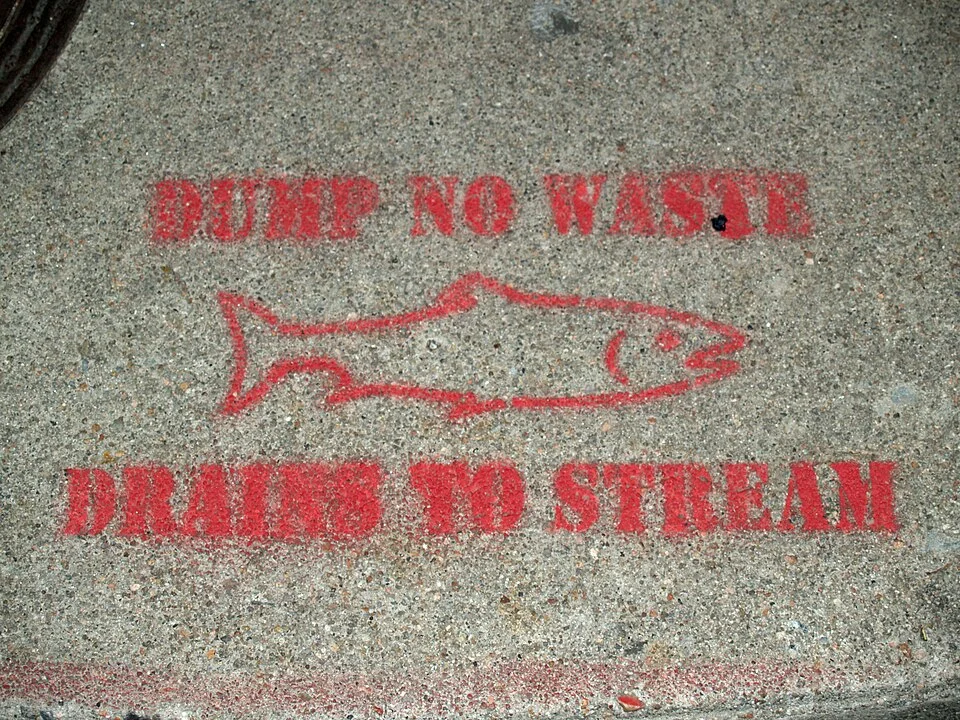
The most useful word on a certain kind of street sign is easy to miss. It is the word “to.” An old stencil photographed on a curb in Colorado Springs tells a person standing beside it not to dump anything and says the drain leads to a stream. Near the message, there is a street inlet and no visible stream. The stencil supplies the part of the map that disappears into the pavement. You can stand beside the sign and follow that connection in your mind even if you have never walked to the water.
A street inlet has a familiar practical job: it gives runoff off the surface somewhere to go. Many municipalities also have reasons to tell residents what could go with it. The first purpose is obvious to someone approaching a curb on a wet morning. The second can be hard to imagine in a neighborhood where the nearest visible water is miles away or lies behind houses. A paint mark joins one ordinary act at a curb to a place beyond the curb. That is a modest public service when the mark is accurate, readable and supported by someone who can answer the next question.
The connection under the grate
Rain lands on a roof, parking lot or paving and begins moving across a surface that may absorb very little of it. It can pass over grit, litter or residue before reaching an inlet. The local system may lead to a waterway, possibly through other infrastructure, under conditions determined by the design. Drainage arrangements are not identical from town to town or even from one part of a city to another. Systems that carry stormwater separately and systems that combine it with sanitary sewage in some places are distinct arrangements. A generic guess about where any grate leads is not a substitute for information from the people responsible for it.
This qualification affects how you write a useful marker. If the utility can identify the receiving water and has approved a message, its name can give the statement a human scale. Someone who knows the downstream creek as a place to walk suddenly has a specific connection to the curb. If the destination is complicated, a different message may be more accurate. Under no circumstances is the uncertainty an invitation to use a street inlet as a place to get rid of waste. The local sanitation or stormwater service can usually direct someone toward the correct disposal route for a particular material.
Look above the grate before trying to make a map. Part of the contributing area may be one side of the road, a side alley or a surface that slopes in from well behind the natural field of view. The uphill curb gives you a clue to the next few meters, not to the pipes below. This is a reasonable observation to make from ordinary sidewalk space. If water has collected on or beside the roadway, an onlooker should keep out of it. The area can contain things whose contours cannot be seen, and a report made from a position of safety gives a crew better information than an attempt to investigate at the grate.
Two messages, two different jobs
A sign about dumping has a different function from a volunteer service that keeps a grate free of leaves. Seattle Public Utilities lists storm drain stenciling and drain adoption as separate activities. A painted marker addresses the actions of whoever notices it. An adoption program gives people a way to help at particular locations, with limits on what volunteers are expected to handle. The same detail of city infrastructure turns up in both programs, but one project makes a relationship visible and the other organizes attention over time.
Those jobs can support each other. A person who recognizes a marked inlet may be more likely to remember where a recurring problem occurs. A local group that walks several streets to inventory labels may spot an old or illegible message that could be added to a scheduled stencil day. Neither job gives a resident authority to inspect pipework or make changes to a drain. The moment a volunteer encounters unsafe conditions, a persistent blockage or damage, the useful role is to document from a safe location and get the information to the agency that can act on it.
There is a reason to give this distinction room on a city webpage or a handout. Someone who visited to learn how to fix a puddle might leave with only encouragement to paint a sign. Someone eager to help with a marking project might believe they signed up to take care of every drain near the sign for the next year. Give each task a contact, a description of what happens and a description of what happens afterward. The difference will make sense to people who have never met anyone in the stormwater department.
The size and angle of a useful message
A stencil has an unforgiving site. The person who reads it may be moving, carrying something, keeping clear of vehicles or watching a younger companion. The surface might be wet in the very weather that makes a storm drain important. In addition to the ordinary problems of type size and contrast, a curb has a top and a face. Sometimes you can see one easily from across the sidewalk and miss the other entirely. The position can make clear lettering disappear from the angle where it matters.
Find out whether the utility already has approved markers, placement guidance and volunteer arrangements. Minnesota’s stormwater manual discusses several kinds of markers and how they can fit into an outreach program. The examples highlight a choice which involves more than replacing faded paint. A surface mark and a manufactured marker differ in how visible they are and how they will be checked or renewed. Locations that are frequently resurfaced or cleaned also change the useful life of a message. A new marker that no one can inspect once it is installed is harder to sustain than the publicity photographs suggest.
Imagine reviewing proposed wording for a particular site. First ask what should be recognized immediately. The thing to avoid might be expressed by a few words. Then ask whether someone has a place to go for a reason, a disposal option or a map. A long link stenciled beside a storm drain is not usually the most legible way to direct people. A short and stable agency name or a consistent mark can give other communications a reference. Read the sign from the actual approach before spending time refining how it looks in a drawing. It can fit on the curb and still be hard to read from the direction most people use.
A report that goes somewhere
A practical observation at an inlet begins with where. In a long road with similar corners, an address or intersection and the side of the street are useful. The time and recent conditions offer more context. Write what could be seen without guessing at the part hidden under the opening. If standing water reached the top of the curb after a period of rain, include that fact. An inferred cause often gets repeated until it is mistaken for a finding; the shape and timing of the visible problem can help the next person do the actual investigation.
Sometimes the first service report may need distinguishing from a later one. After a clean-up or an inspection, someone should be able to tell whether the same thing occurred again. Write a fresh observation and refer to an earlier report if you can. That allows a utility or organizer to tell repeated events from repeated messages about one event. It is a modest bit of organization that makes it easier to follow up without putting the people who live near the corner in charge of solving the drainage design.
If the issue is readability rather than flooding, describe that separately. “Stencil unreadable at the north end of the marked crossing” is a different finding from “water pools across the path in wet weather.” Both may be true and may require different schedules and people. A block can improve how it explains the destination of runoff while avoiding inflated claims about how much water will now reach that destination or how clean the water will be. Those outcomes require other kinds of observation and evidence.
Come back on a dry day
Before planning a new round of outreach, try following the old message at the pace of an ordinary walk. At one corner it may be obscured by a newly placed bin. At another the painted fish survives but the words that name a stream have disappeared. Further uphill the warning is visible at once even in faded paint, because the viewing area was well chosen. Compare these sites in the same conditions. The one issue worth fixing may not be the quality of a stencil at all; it might be the position in the path.
A neighborhood group can use that experience to make a brief record for the next work day. Keep the locations, the authority’s approved wording, whether each site was marked or deferred, and whether anyone will check back after later street work. Keep facts distinct from hopes: the location of a new sign is knowable at the end of the day; a reduction in dumping is a separate result. Even the simpler record prevents three people from agreeing to inspect the same corner while a crossing one block away has been missed.
Walk by the photograph’s curb in your mind one last time. The near thing is a dark slit beside the street. The distant thing is a stream you cannot see. A tiny arrow in a person’s understanding joins the two before they take another step. There will still be problems that need an engineer, maintenance worker or actual change to the road. But the small sign has achieved its task if someone knows where the next drop of dirty water is headed and whom to ask about keeping the stream clean.